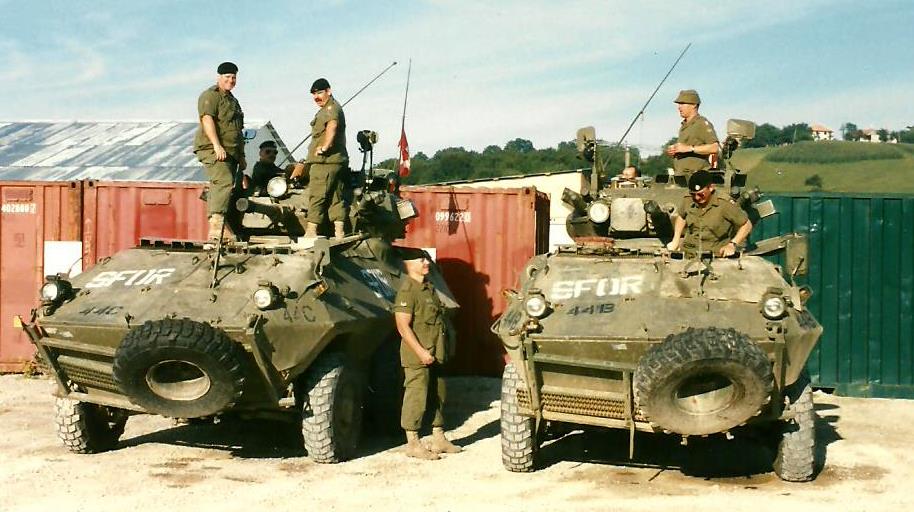
OP SHARP GUARD 10 Dec 95 to 25 Mar 96, Capt (N) (Ret'd) Kevin D.W. Laing, CO HMCS Fredericton
WARNING: Due to the nature of the conflict and operations in the Balkans, some of these veterans' stories may contain graphic or disturbing content. Please use your discretion. If a story adversely affects your mental health, consider seeking help by consulting the agencies listed in the Resources section of this website.
Operation SHARP GUARD
International Operation Name: Operation SHARP GUARD
International Operation Dates: 1993/06/15 – 1996/06/19
Mandating Organization: United Nations
Region Name: Europe
Location: Adriatic Sea
Canadian Operation Name: Operation SHARP GUARD
Canadian Operation Dates: 1993/06/24 – 1996/05/16
Mission Mandate:
To enforce United Nations Security Council Resolutions embargoing imports into the Federal Republic of Yugoslavia (Serbia and Montenegro).
Mission Notes:
The degeneration of the political and military situation in the former Yugoslavia resulted in the United Nations creating the United Nations Protection Force in an attempt to moderate the situation in Bosnia-Herzegovina and Croatia. An arms embargo was also declared against the Federal Republic of Yugoslavia (FRY - Serbia and Montenegro) with the passing of Security Council Resolution 713 on 25 September 1991. Both the North Atlantic Treaty Organization (NATO) and the Western European Union (WEU) provided ships to enforce the embargo, while NATO also provided maritime patrol and airborne early warning aircraft. However, the resolution did not actually allow sufficient powers to halt any suspected violators, simply registering them.
The Security Council passed resolution 757 on 30 May 1992 that provided greater teeth to the enforcement of the embargo and expanded the list to all items except foodstuffs and medicines. NATO and the WEU continued to provide ships, and the former aircraft to support their respective operations. On 17 April 1993, the Security Council passed Resolution 820, which prohibited all vessels from entering the territorial waters of the FRY. On 8 June, at a joint session of the North Atlantic Council and the WEU, the two organizations decided to combine their operations that were supporting the enforcement of the embargo against the FRY. The new operation was named Operation SHARP GUARD and came into effect on 15 June 1993.
Op SHARP GUARD consisted of two naval task forces –one from the WEU and one from NATO, operating under the name Combined Task Force 440. NATO's was based on the Standing Naval Force Atlantic (STANAVFORLANT) or Standing Naval Force Mediterranean (STANAVFORMED). They operated under a NATO operational control, augmented by WEU staff officers. NATO maritime patrol aircraft flew over the Mediterranean and Adriatic Seas to identify merchant vessels and generate a picture of where all ships were in the Adriatic. NATO Airborne Early Warning Aircraft provided a coordination and control function, identifying air and sea threats, and notifying the appropriate NATO vessel and the CTF 440 headquarters.
The ships deployed on Op SHARP GUARD operated right up to the 12-mile territorial limit of FRY waters. Albania had given permission for Op SHARP GUARD vessels to enter its territorial waters to conduct the enforcement. The ships were maintained at a high state of alert while operating off the FRY waters. The FRY had a navy that posed a considerable threat, including highly capable submarines. There were also land-based anti-shipping missiles and aircraft that could carry out anti-shipping strikes. On numerous occasions, FRY ships and aircraft conducted activities that could have been construed as hostile, including aircraft making what to all appearances were attack runs against the ships. Only the calm resolution of some ships' Captains prevented fire being opened against the offending FRY combatant.
After the signing of the Dayton Peace Accord in December 1995, events began to calm down in Bosnia-Herzegovina. The Security Council, noting that an agreement had been reached in Dayton, Ohio in November, agreed to lift the embargo in a phased process starting 90 days after the FRY had signed the agreement. Resolution 1021 was authorized on 22 November 1995. Security Council Resolution 1022 passed the same day lifted other aspects of sanctions imposed against the FRY and Bosnian Serbs. With the authorization of these two resolutions, Op SHARP GUARD began to wind down, finally terminating on 19 June 1996.
Canadian Mission Notes:
Canadian participation in Op SHARP GUARD also used that operations name and consisted of both naval and air forces. The initial response was to send HMCS Algonquin, which was then flagship of the Standing Naval Force Atlantic (STANAVFORLANT), to Op SHARP GUARD when NATO sent STANAVFORLANT to support the new operation on 8 June 1993.
Algonquin was the first of 11 deployments, with two ships deploying twice.
Because of the capabilities of the Canadian ships, they normally found themselves in the forward operation areas closest to the FRY territorial waters. On occasion they came near harm’s way, having had a FRY aircraft conduct an attack run against one ship, and on other occasions being targeted by the FRY fire control radars. On another occasion, a Canadian warship interposed itself between a FRY warship and a fishing vessel that it had attacked.
More significantly, the Canadian warships conducted hundreds of hailings and over 100 boardings and inspections of vessels resulting in about a dozen vessels being diverted to Italian ports for more detailed inspections.
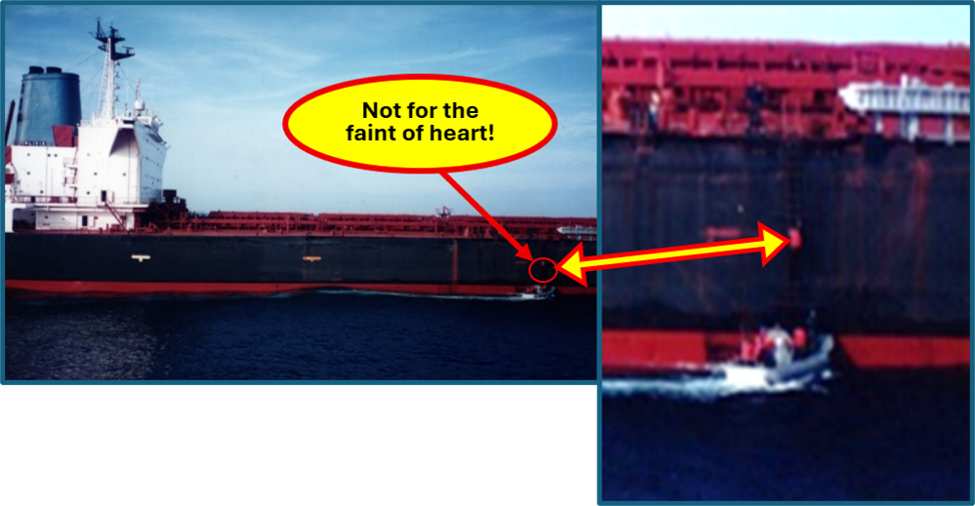
These boardings normally involved bringing a rigid hull inflatable boat (similar to a zodiac) alongside the vessel, climb five or more stories up an often-wet ladder, sometimes in heavy seas. The Canadian boarding party would then show every respect to the captain and crew of the merchant vessel while conducting the inspection. On occasion, the ship's helicopter was used to fly the boarding party to the vessel being inspected.
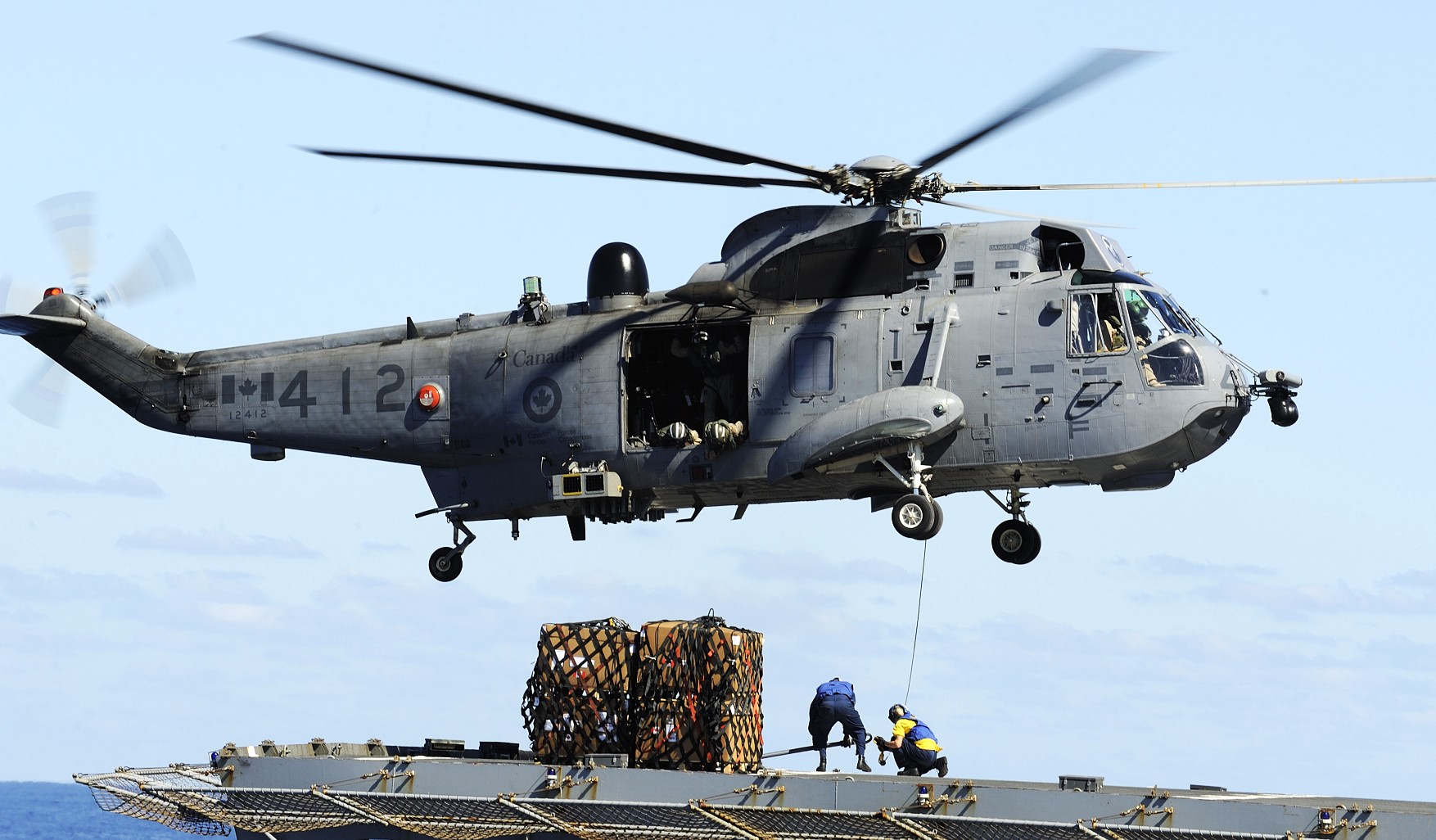
(DND Photo)
The Canadian warships normally deployed with an embarked CH-124Sea King helicopter. Most of the Sea Kings were configured for anti-submarine warfare, which was a prudent consideration given the submarine capability of the FRY navy. They were also equipped with Forward-Looking Infra-Red and stabilized binoculars to allow search and identification of vessels at sea, as well having chaff, flares and missile warning systems. The Sea Kings thus extended the operational capability of the warships.
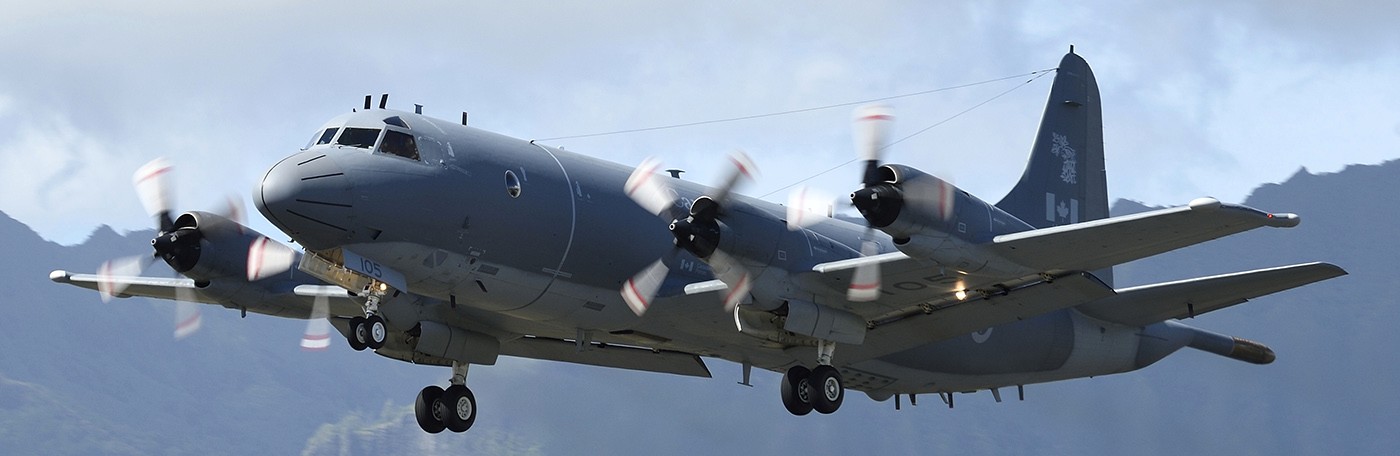
(DND Photo)
The Canadian Air Force provided a valuable contribution to Op SHARP GUARD beyond the Sea King helicopters deployed on HMC Ships. From August 1993 to May 1994, and again from May 1995 to September 1995, two CP-140 Auroras were deployed to Sigonella, Italy, to conduct patrol flights over the Mediterranean and the Adriatic. The flights over the Adriatic were particularly challenging as they were within a few minutes flying time of any hostile FRY aircraft, with the Auroras being lit by fire control radar on occasion. Immediate evasive action was required on such events as it could indicate that a surface-to-air missile could be on the way. The Auroras flew at least one mission every day, each mission being 10 hours long. By conducting general reconnaissance flights and identifying vessels, the Auroras allowed commanders to build up a picture of the situation at-sea and identify the location of potential embargo-runners.
(DND Photo)
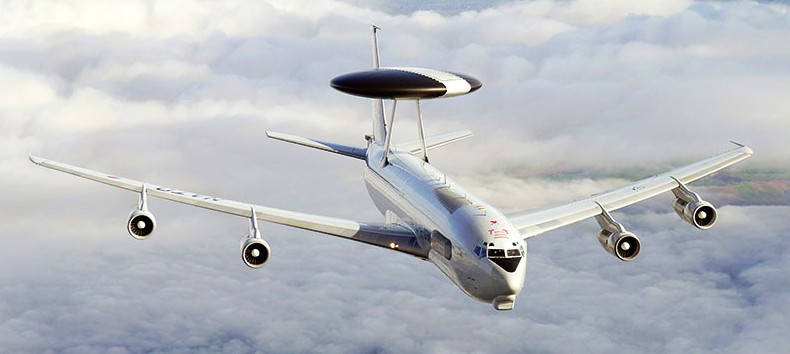
Canadian Air Force personnel also served with the NATO Airborne Early Warning Force (NAEWF). The NAEWF, based in Geilenkirchen, Germany, used Boeing E-3A Sentry aircraft to observe the air traffic over large areas of the Adriatic and the former Yugoslavia. The E-3s also provided a capability to coordinate the various resources that could respond to a threat or manage a situation. Every Sentry flight contained Canadian crew members.
The Canadian naval contribution to Op SHARP GUARD ended on 15 May 1996 when HMCS Halifax departed. The Air Force's Aurora contribution ended in September 1995. The personnel with the NAEWF flew missions until the end of the operation. An estimated 3,400 Canadian Armed Forces personnel participated in Op SHARP GUARD.
The content of this foregoing webpage was largely prepared by the Operational Records section within the Directorate of History and Heritage (DHH).

DEPLOYMENT PREPARATIONS
HMC Ships that are deployed on operational missions are normally “High Readiness” units which must be fully capable operationally and available to deploy within 10 days. The units that are assigned as “High Readiness” have the highest priority in the HMC Dockyards for technical, logistical and personnel upkeep and support. These units have generally followed a similar building-block path to become “High Readiness:”
• Initial Material Readiness focus; completed a refit or an extended maintenance period to ensure that all systems related to a ship’s engineering plants for propulsion, electrical, hotel services; and Combat Systems for communications, sensors, above/surface/subsurface weapons (hard and soft kill), data links and information management are fully operational and meet design specifications.
• While the ship undergoes the material readiness portion, personnel posted to the ship are identified and verified to have been trained to the prescribed level for their
rank and trade. Short-falls are highlighted and remedied by further individual training (first-aid, fire fighting, damage control, small arms, etc). Next are collective
departmental and team training (section-based damage control and firefighting teams, casualty clearing, boat-work, diving teams, Boarding Party, Blind Pilotage
(navigating in reduced visibility) and Command Team Training. Many of these collective/team training activities are simulated first ashore and then verified at sea.
• The culmination of these preparations is successful completion of the final “exam” “Work-Ups” (WUPs) which is an all-hands evolution conducted over roughly a
month. Normally, it progresses from four or five days alongside in harbour or at anchor to verify the Watch and Station Bill (W&SB).
o A key element to WUPs success is the work that the Cox’n and Senior Chiefs do to completely fill out the Ship’s W&SB. This is the allocation of suitably trained personnel to each of the positions required to respond to all situations from normal peacetime cruising all the way up through the degrees of readiness: third, second and first (Action Stations!). There are additional requirements to identify specialist personnel positioned to respond to emergencies in firefighting, damage control, helicopter emergencies, medical cases, man overboard, and other rescue situations. As well, it names suitably trained folks to critical positions where more experienced personnel assume positions in the Machinery Control Room, various Combat System spaces like the Ops Room, Communication Control Room, and technical equipment spaces; plus the Watch on Deck positions (helmsman, lookouts, roundsmen, etc.) and Bridge Watchkeepers like Officers of the Watch, signalmen, communicators and part of ship personnel for Replenishment at Sea and entering and leaving harbour. Suffice to say, that there are more positions in the W&SB to be manned than there are personnel on board!
• So, everybody has more than one responsibility! This is why the organization of the W&SB is so fundamental and critical to a ship’s success in WUPs and is often the
first item that the Sea Trainers deal with. There is no sense inflicting the pains (and the resources) of emergency tests on the ship if the W&SB is faulty.
• Once the W&SB manning appears sound, the ship gets underway at sea for a few days to confirm/verify the ship’s abilities in peacetime cruising with several
unalerted emergencies sprinkled throughout the daily flex program which could include conducting weapons firings, flight operations, boat-work (man-overboard
recovery, securing to a buoy, anchoring, etc.). After a weekend break alongside (home or foreign port), Sea Trainers and WUPs returns with a vengeance at 0600
with emergency stations to counter fire or flood or perhaps a bomb-threat which produces said emergency. Then it’s on to an Opposed Departure (countering sea
mines, submarines and shore-based threats) in conditions of reduced visibility (Blind Pilotage) that required transiting in “Action Stations” wearing helmet, flak
jackets, anti-flash gear and if the scenario calls for it, gas masks and suits for countering Nuclear, Biological, and Chemical attack.
• For the last week, you are with consort ships and are responsible to generate all of the orders and messages to accompanying unit(s) to complete Sea Training’s
scenarios countering multi-threat (air/surface/subsurface) and other planned and unalerted emergency events (fire/flood/damage control and casualty evacuations)!
• Clearly, we all work to succeed in WUPs, but there are some instances when things don’t quite work out. Should the Commander Sea Training and his staff believe that
there are some issues that hamper the ship’s performance, he may recommend to the Squadron or Fleet Commander that changes are required. If equipment failure is
the cause of the problem, some workarounds in scheduling repairs may be accomplished depending on the nature and the severity of the work required. Most
often, however, the focus is personnel related and the Command team (CO/XO/Cox’n) is the initial focus with department head Officers and Chiefs a more
distant second. Reliefs may be identified and pier-head jumps accomplished within a few days with little impact on the ship’s overall deployment schedule.
Of course, some of the ships committed to OP SHARP GUARD were diverted from other previous taskings. It is hoped that the units affected by a re-assignment to OP
SHARP GUARD can highlight any issues which may have impacted their participation.
During the 1990s, the maritime embargo operations in the Adriatic Sea were established to ensure compliance by Serbia and Montenegro with United Nations (UN)
resolutions 713, 715, 787, 820 and 943. Between November 1992 and June 1996 some 74,000 ships were challenged, almost 6,000 were inspected at sea and more than
1,400 were diverted and inspected in port.
Please encourage your shipmates to share their memories and photos so that we may all be remembered! Even better would be participating in video interviews to tell your stories! Surely there must be some “Tall Tales” which can be shared!
During the Cold War, STANAVFORLANT was normally positioned off the northwestern coast of Europe, tasked with defending the North Atlantic. Prior to 1993,
STANAVFORLANT ships spent most of their time conducting training exercises in conjunction with Allied navies in the Atlantic from western Europe to the east coast of
North America and the Caribbean Sea. The conflict in the former-Yugoslavia, and the call from the United Nations to enforce sanctions against the belligerents, changed that.
STANAVFORLANT ships moved into the Adriatic Sea and became heavily involved in Operation Maritime Monitor (July 1992 to November 1992), Operation Maritime
Guard (November 1992 to June 1993) and Operation Sharp Guard (June 1993 to October 1996). Algonquin was the first Canadian ship of 11 OP SHARP GUARD
deployments, with two ships deploying twice.
COMSTANAVFORLANT OP SHARP GUARD
Dates as COMSTANAVFORLANT??
Then COMMODORE Gregory R. Maddison, CMM, MSC, CD
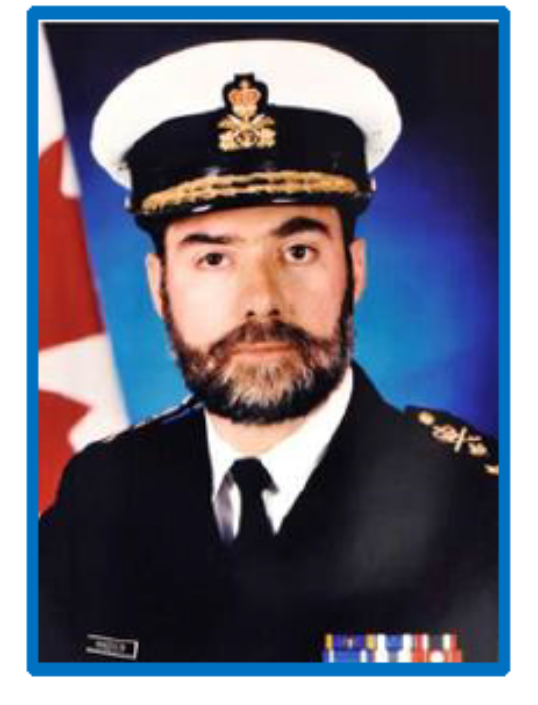
"Commodore Maddison was the principal commander of the North Atlantic Treaty Organization’s operation that conducted a successful embargo in support of the United Nations off the coast of the former Yugoslavia, from April 1993 to April 1994. Under continuous threat of retaliation, his force spent an impressive amount of time at sea and executed a large number of sensitive boarding and interception operations. He achieved high levels of combat readiness and helped inspire a great spirit of cohesion and pride within his dispersed squadron, demonstrating the highest standards of leadership and command. Throughout, he earned the unqualified respect and confidence of all with whom he worked."1
COMSTANAVFORLANT’s Perspectives
1| The Governor General of Canada Honours Recipient – Meritorious Service Cross – VAdm Gregory Ralph Maddison: Awarded on: 1995-03-10; Invested on: 1995-05-31. As accessed 2 Aug 2026.
HMCS ALGONQUIN (DDG-283)
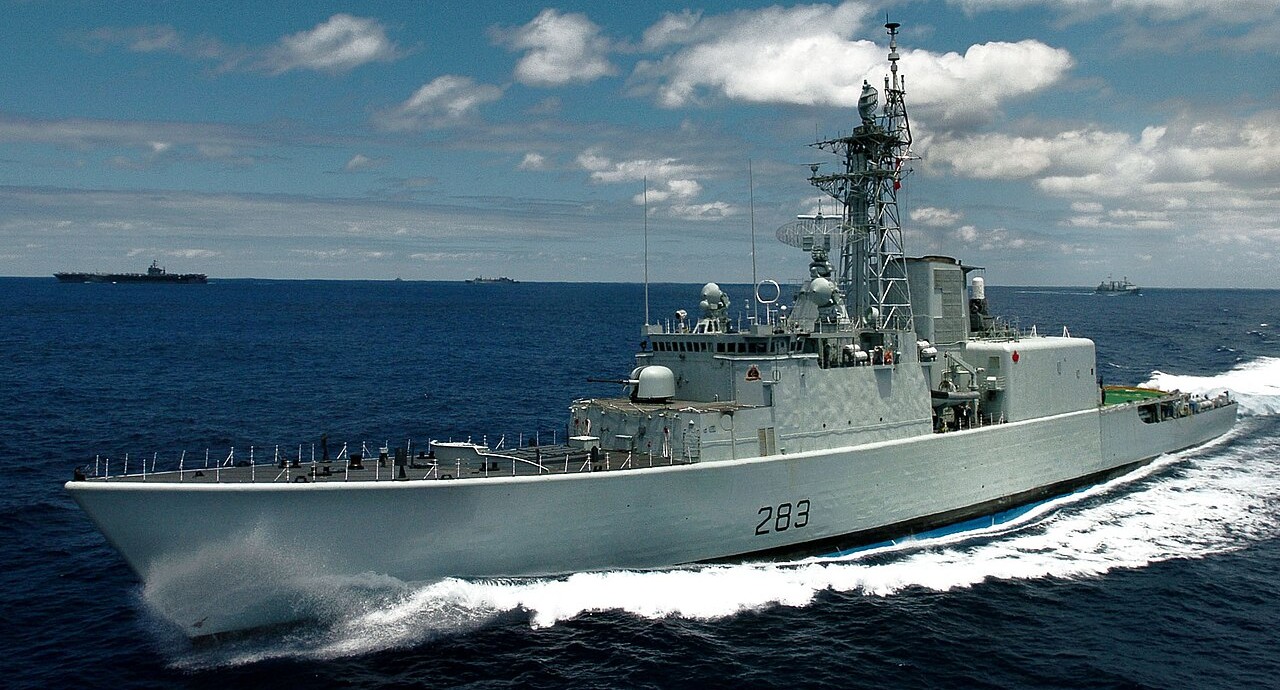
(U.S. Navy Photo by Photographer's Mate 2nd Class Jayme Pastoric)
HMCS Algonquin (DDH 283), 24 June to 3 October 1993.
OP SHARP GUARD 24 JUNE 1993 – 3 OCTOBER 1993
OVERVIEW:
Request ALGONQUIN provide perspectives of participating OP SHARP GUARD. Wikipedia indicates that she had to transit the Suez Canal. What operations was she
conducting that required her to transit (presumably north bound) the Suez Canal?
• any “scary” ops? Boardings, ROE challenges
• “ACTION STATIONS” for real? i.e. FRY EW simulated attack profiles?
• Notable Weather events
• Port visits? Significant visitors?
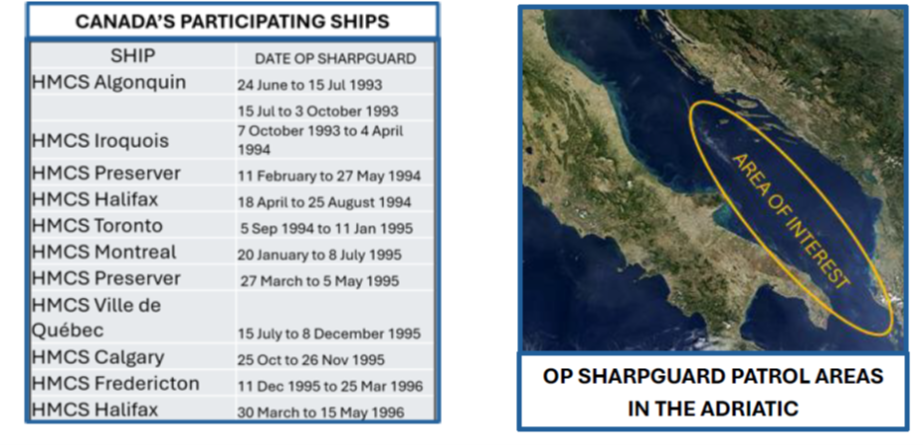
OP SHARPGUARD PATROL AREAS IN THE ADRIATIC
• Stats - boardings, hails, diversions?
• Photos, press media?
Info from Posterity’s Sake: On 29 Mar 1993, ALGONQUIN sailed to join SNFL, again as flagship.
From Wikipedia: On 29 March 1993, Algonquin sailed to join STANAVFORLANT, arriving in April. She was once again made flagship and transited the Suez Canal to join the other NATO vessels enforcing the blockade of the former Yugoslavia in the Adriatic on 24 Jun 1993 as part of Operation "Sharp Guard". On 2 July, Algonquin conducted the first of a total of 88 merchant vessel boardings as part of the blockade. On 27 July, the busiest day for Algonquin boarding parties, seven merchant ships were boarded in a 23-hour period. On 1 October, the ship completed her last boarding in support of the operation. On 5 October, Algonquin completed turnover of STANAVFORLANT to HMCS Iroquois and returned home.
INPUT FROM ALGONQUIN’S SHIP’s COMPANY
HMCS IROQUOIS (DDG-280)
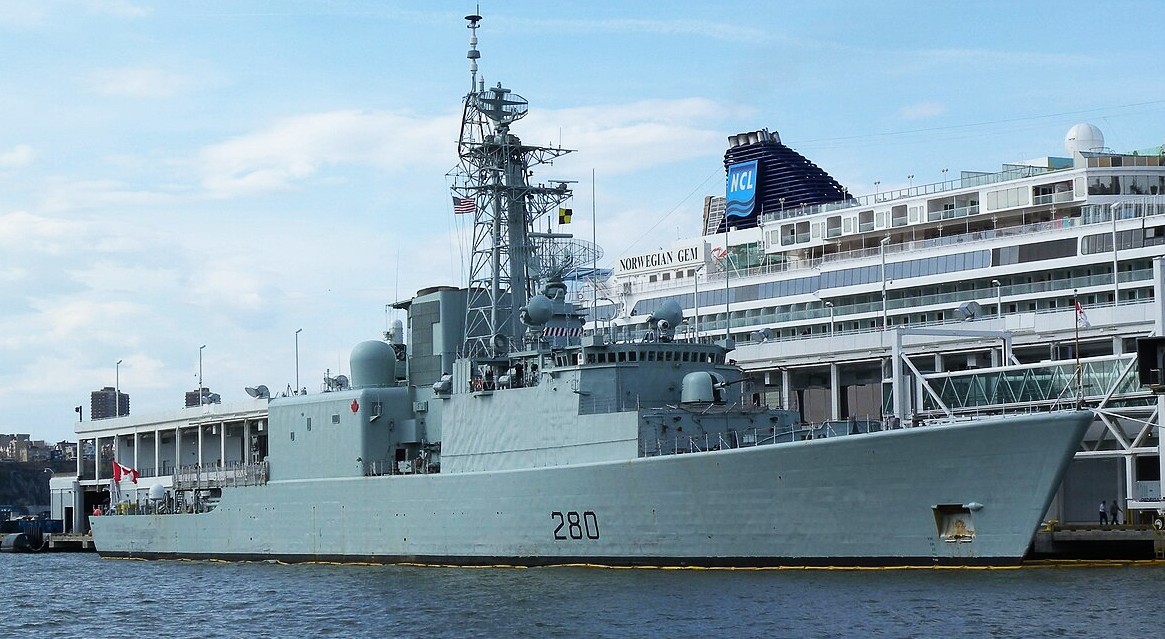
(Jim Henderson Photo)
HMCS Iroquois (DDH 280), 7 October 1993 to 4 April 1994.
OP SHARP GUARD 7 OCTOBER 1993 – 4 APRIL 1994
OVERVIEW:
Request IROQUOIS provide perspectives of participating OP SHARP GUARD. From Posterity’s Sake: Between 25 Sep 1993 and 15 April 1994 Iroquois served with
the OP SHARP GUARD blockading force off the former Yugoslavia. While so employed she conducted 98 boardings. Relieved by HMCS HALIFAX ON 15 April 1994, she
returned to Halifax, arriving on 25 April 1994.
From Wikipedia: Iroquois deployed to the Adriatic Sea succeeding sister ship ALGONQUIN as flagship of STANAVFORLANT from 25 September 1993 to 25 April
1994 as part of the blockade force enforcing sanctions on Yugoslavia. IROQUOIS intercepted a vessel attempting to evade the blockade carrying tanks and
ammunition.[7]
Request more details reference the vessel trying to deliver tanks & ammunition. How did IROQUOIS learn about this vessel/ How did the boarding unfold?
Any issues joining SNFL? SNFL PACKUP? CSNFL Staff embarked?
• “scary” ops? “ACTION STATIONS”? i.e. FRY EW simulated attack profiles?
• Stats - boardings, hails, diversions, boardings, ROE challenges,
• Port visits? Significant visitors?
2https://quotulatiousness.ca/blog/wp-content/uploads/2015/04/HMCS-Iroquois-DDG_280.jpg as accessed
20 Jun 2026.
• Stories, photos, press media?
INPUT FROM IROQUOIS SHIP’s COMPANY
HMCS PRESERVER (AOR 510)
.jpg)
(USN Photo by Mass Communication Specialist Petty Officer 2nd Class Erica R. Gardner)
HMCS Preserver (AOR 510), 11 February to 27 May 1994.
OP SHARP GUARD 11 FEBRUARY 1994 – 27 MAY 1994
OVERVIEW:
Request PRESERVER provide perspectives of participating OP SHARP GUARD. Any unique arisings given that AORs are HVUs performing typical FFH duties?
From Posterity’s Sake: On 27 January 1994, PRESERVER departed Halifax for OP SHARP GUARD in the Adriatic off the coast of Yugoslavia She arrived in the theatre of
operations on 10 February 1994 and returned to Halifax on 14 June 1994.
From Wikipedia: In 1994, PRESERVER was part of the multinational force enforcing sanctions on the former Yugoslavia. The vessel returned to SNFL in May–June 1995.
Any issues about joining SNFL (relief of HMCS ???/when/where)
• SNFL PACKUP
• CSNFL Staff embarked?
Operations - anything notable?
• any scary ops?
• ROE challenges
• “ACTION STATIONS” for real i.e. FRY EW simulated attack profiles?
• Stats - boardings, hails, diversions
• Notable Weather events
• Port visits?
• Significant visitors?
INPUT FROM PRESERVER’S SHIP’s COMPANY
HMCS HALIFAX (FFH 330)
_en_route_to_Haiti_2010-01-18%20(1).jpg)
(MC2 Kristopher Wilson, USN Photo)
HMCS Halifax (FFH 330), 18 April to 25 August 1994.
OP SHARP GUARD 11 FEBRUARY 1994 – 27 MAY 1994
OVERVIEW:
Request HALIFAX provide perspectives of participating OP SHARP GUARD.
From Posterity’s Sake: On 2 Apr 1994, Halifax sailed to relieve Iroquois in the multinational arms embargo of the former Yugoslavia. While enroute, the diesel cruise
engine failed and the ship had to proceed on its gas turbine engines. She arrived in the Op Area for OPERATION SHARP GUARD on 15 Apr 1994; returning home on 9
Sep 1994.
From Wikipedia: On 2 April 1994, Halifax sailed to relieve the destroyer Iroquois as Canada's contribution to the naval blockade of Yugoslavia in the Adriatic Sea. While in
transit to Adriatic, the ship's diesel engine broke down, and the frigate was forced to continue on gas turbines only. Halifax's tour ended when the ship returned to Halifax on 9 September.
Joining SNFL (relief of HMCS PRESERVER when/where); SNFL PACKUP? Alternate flagship?
Operations - anything notable? Any scary ops?; “ACTION STATIONS” for real i.e. FRY EW simulated attack profiles?; ROE challenges? Stats - boardings, hails, diversions?
Any notable Weather events; Port visits? Significant visitors?
**
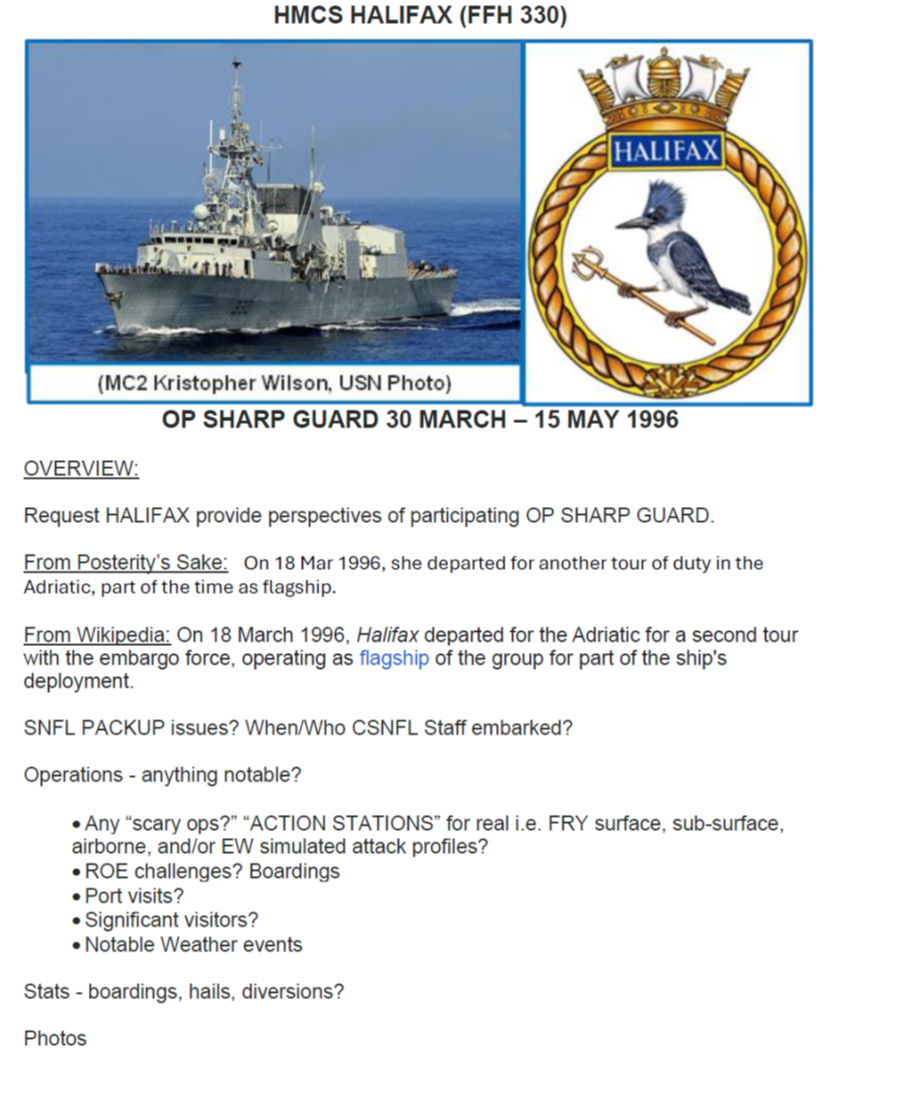
HMCS HALIFAX (FFH 330)
OP SHARP GUARD 30 MARCH – 15 MAY 1996
OVERVIEW:
Request HALIFAX provide perspectives of participating OP SHARP GUARD.
From Posterity’s Sake: On 18 Mar 1996, she departed for another tour of duty in the Adriatic, part of the time as flagship.
From Wikipedia: On 18 March 1996, Halifax departed for the Adriatic for a second tour with the embargo force, operating as flagship of the group for part of the ship's
deployment.
SNFL PACKUP issues? When/Who CSNFL Staff embarked?
Operations - anything notable?
• Any “scary ops?” “ACTION STATIONS” for real i.e. FRY surface, sub-surface, airborne, and/or EW simulated attack profiles?
• ROE challenges? Boardings
• Port visits?
• Significant visitors?
• Notable Weather events
Stats - boardings, hails, diversions?
Photos
INPUT FROM HALIFAX’S SHIP’s COMPANY
HMCS TORONTO (FFH 33)
_3.jpg)
(U.S. Navy Photo by Photographer's Mate 1st Class Brien Aho)
HMCS Toronto (FFH 333), 5 September 1994 to 11 January 1995.
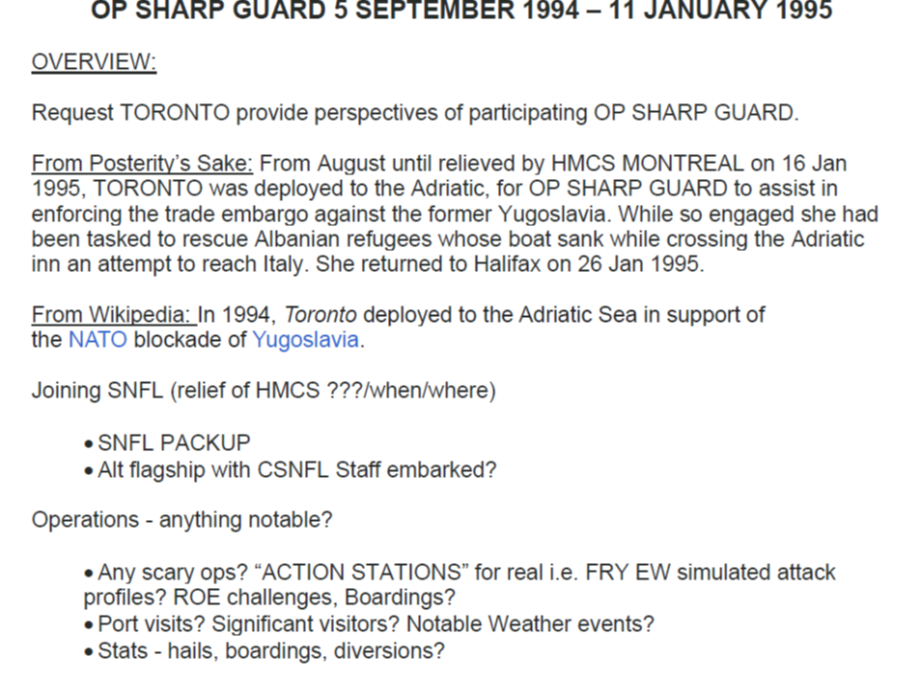
HMCS MONTREAL (FFH 336)
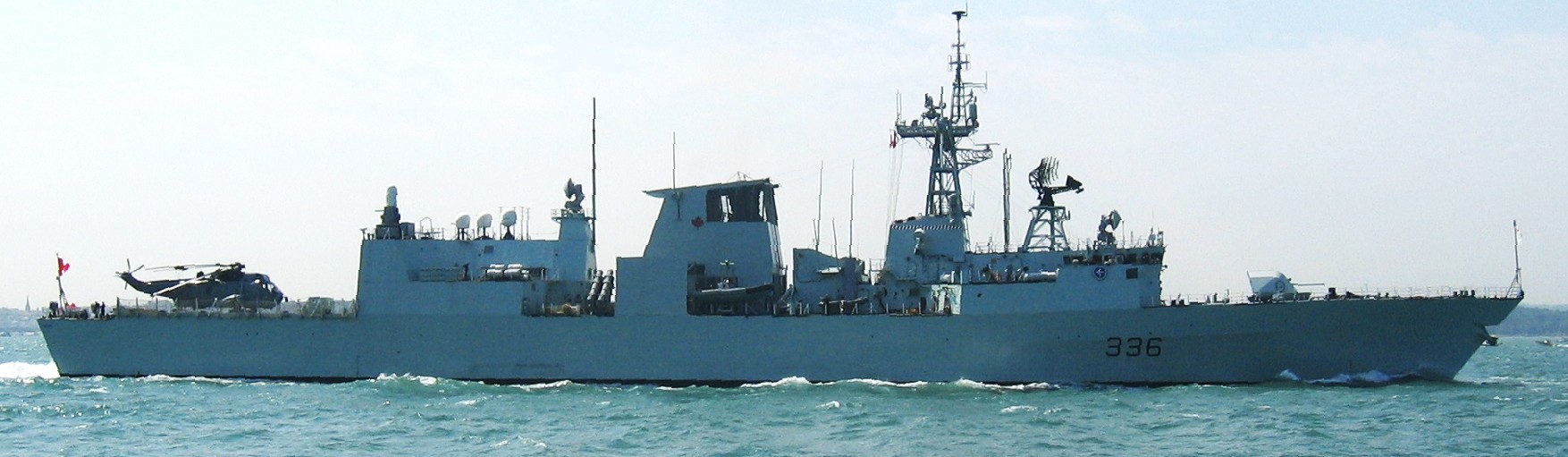
(Bruce Davidson Photo)
HMCS Montreal (FFH 336), 20 January to 8 July 1995.
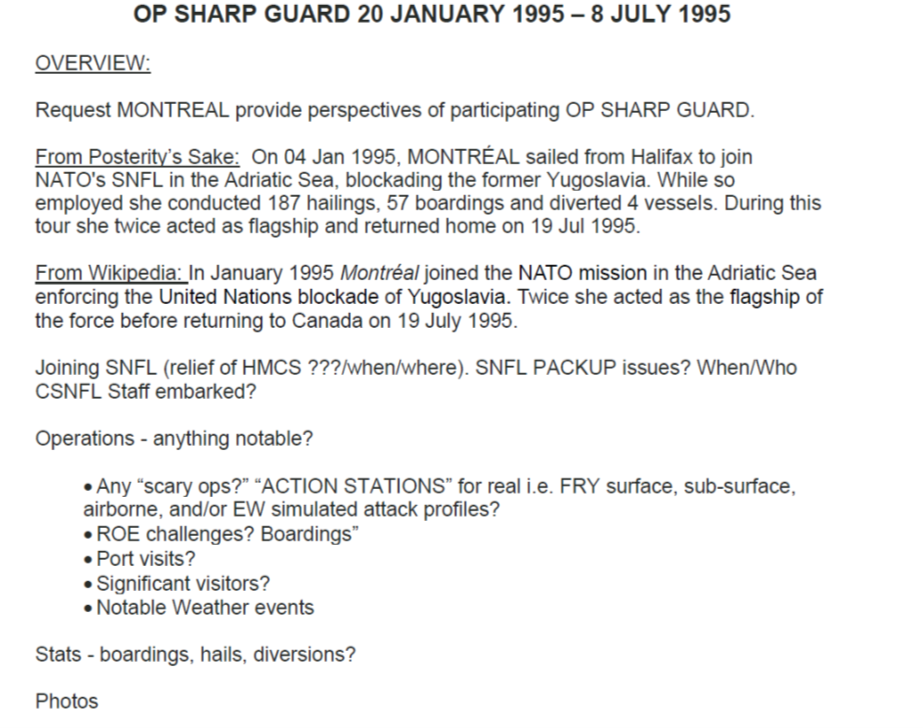
INPUT FROM MONTREAL'S SHIP'S COMPANY
HMCS VILLE de QUEBEC (FFH 332)
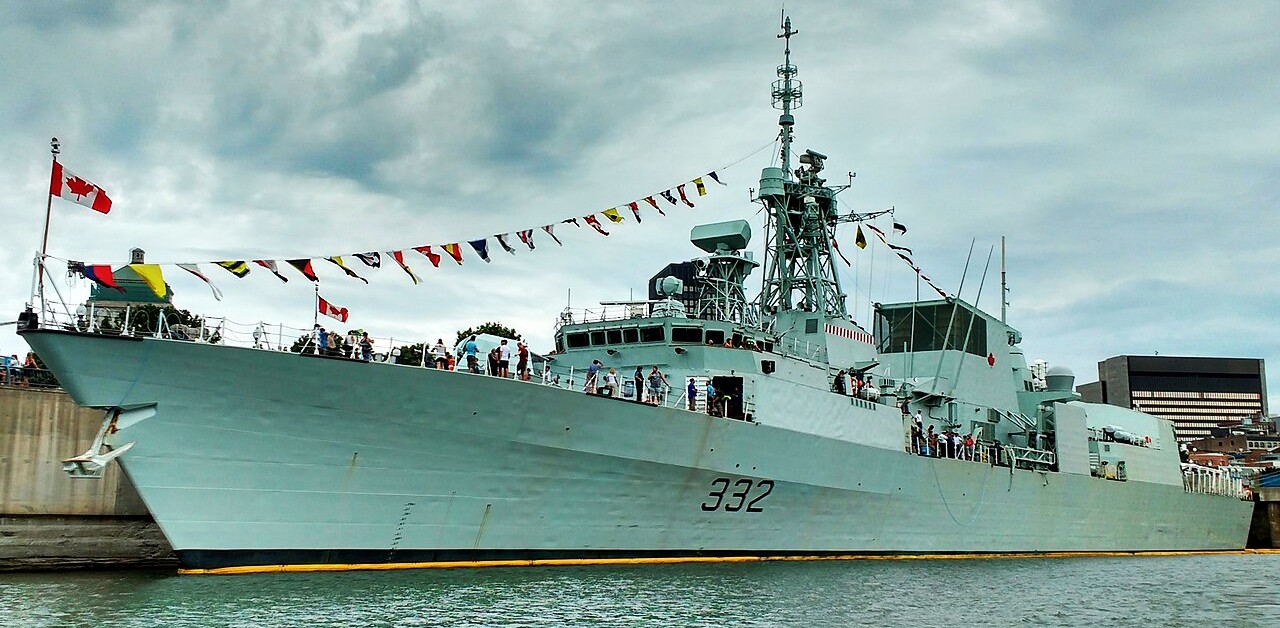
(RedAndr Photo)
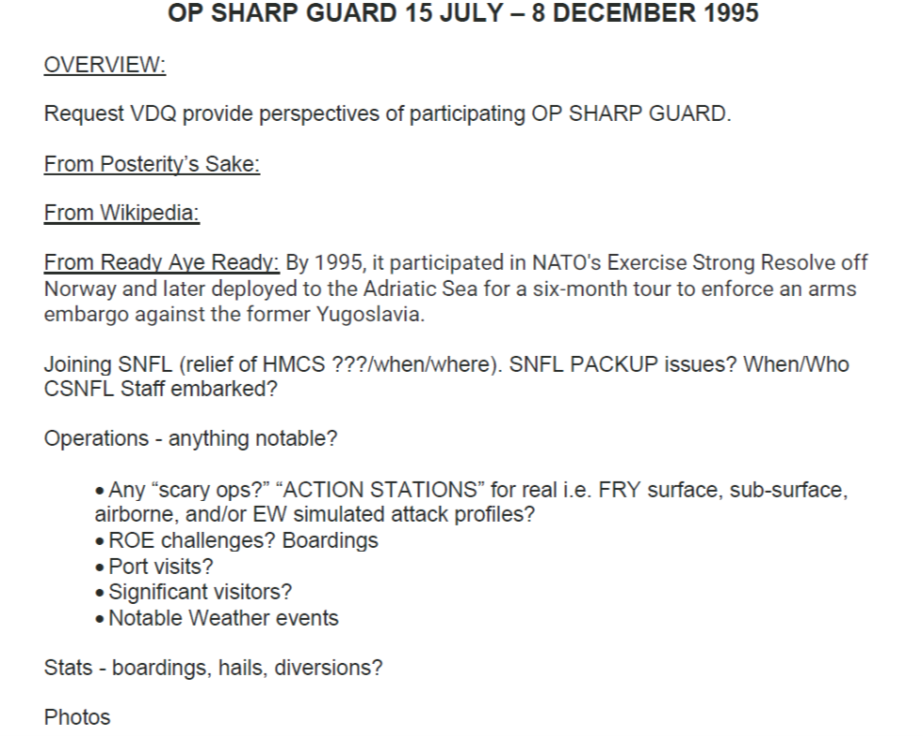
HMCS Ville de Québec (FFH 332) 15 July to 8 December 1995.
INPUT FROM VILLE de QUEBEC'S SHIP'S COMPANY
HMCS CALGARY (FFH 335)
_leaves_Pearl_Harbor_in_July_2014.JPG)
(U.S. Navy Photo by Canadian Armed Forces Sgt. Matthew McGregor)
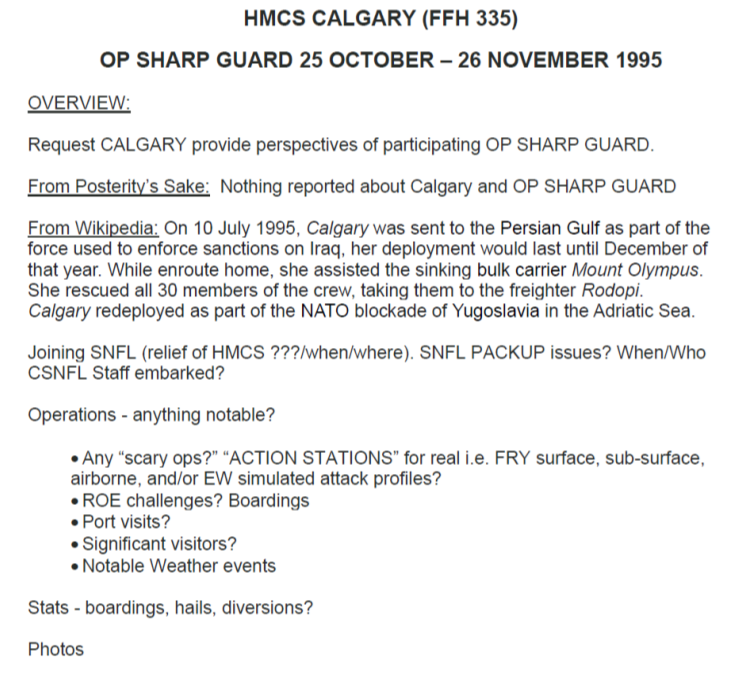
HMCS Calgary (FFH 335), 25 October to 26 November 1995.
INPUT FROM CALGARY'S SHIP'S COMPANY
HMCS FREDERICTON (FFH 337)
.JPG)
(Christopher R. Shrank, U.S. Navy Photo)
HMCS Fredericton (FFH 337), 11 December 1995 to 25 March 1996.
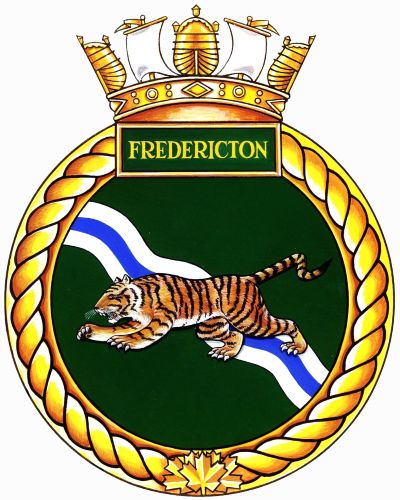
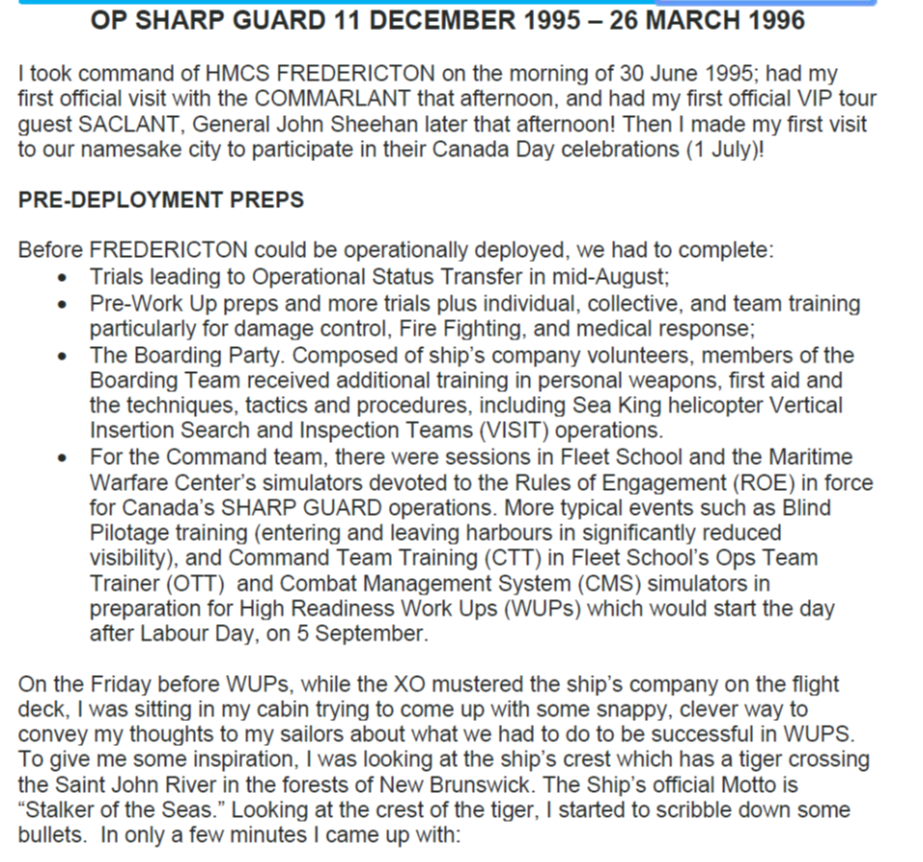
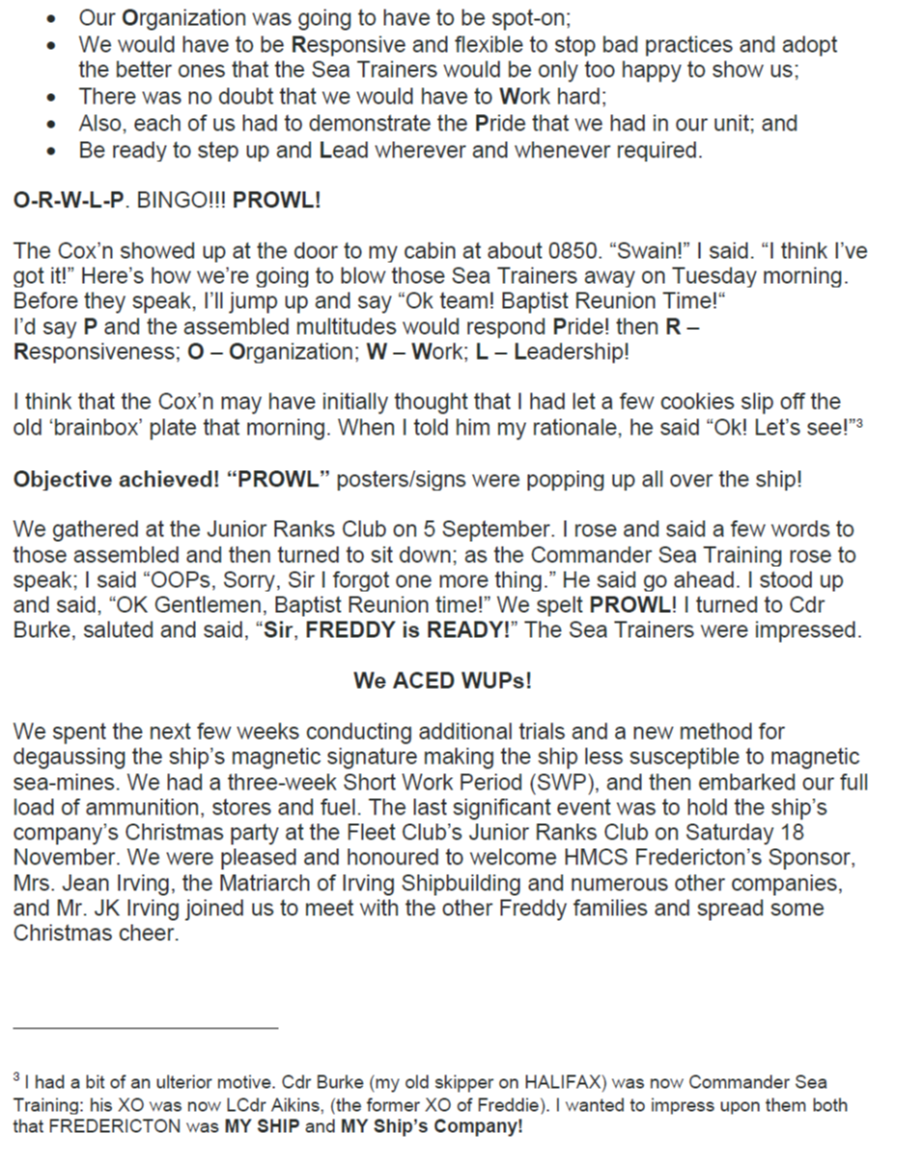
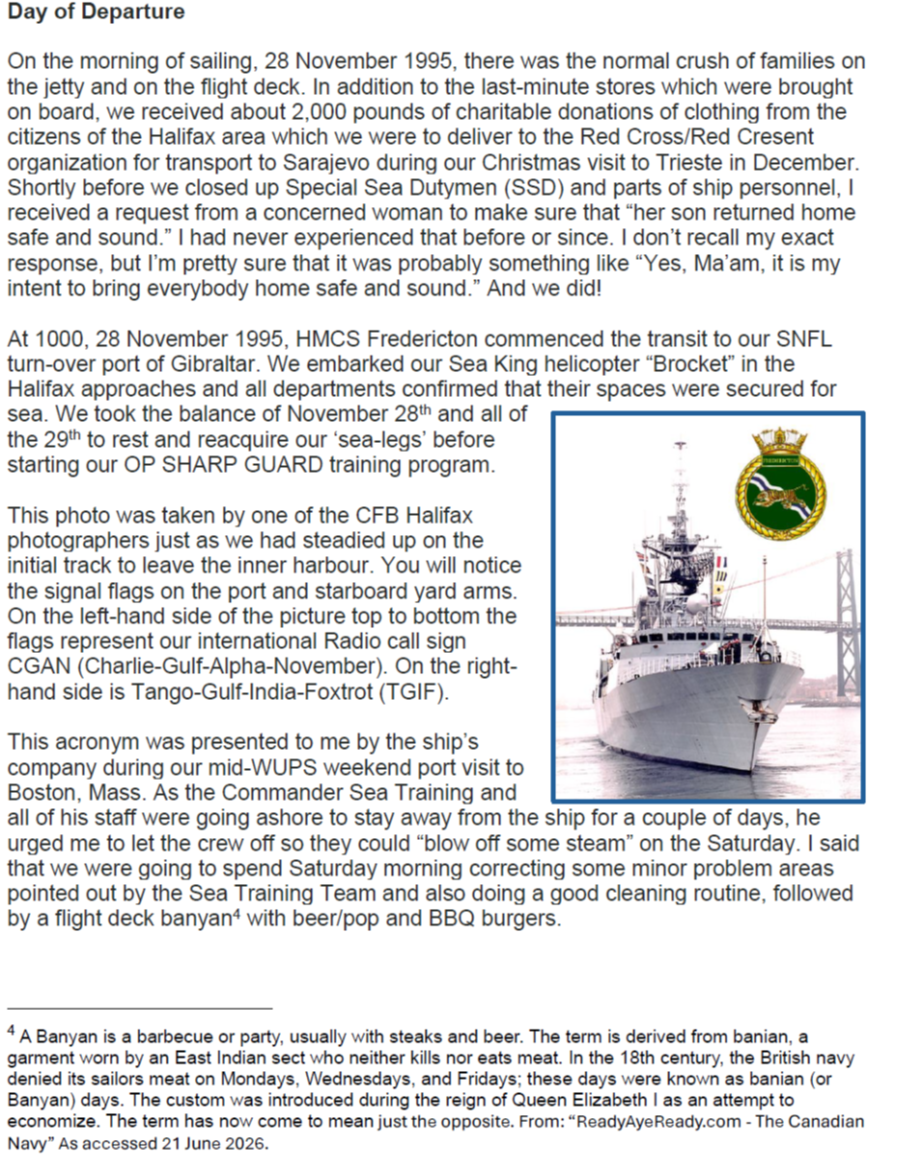
During the banyan, I was cornered by a couple of Leading Seamen and an Airforce corporal who said that they had a new acronym for me. I was a bit concerned about what they could do with “P-R-O-W-L.” So, what was their acronym? “TGIF” meant "Thank God I’m FREDDIE!” It almost brought me to tears. Henceforth, every sitrep I sent to my in-theater Commanders and to MARLANT in Halifax had TGIF as the last paragraph. Another point concerning sitreps was that every daily SITREP message that I, as CO FREDERICTON, released and sent back to MARLANT info NDHQ had a Date Time Group (DTG) based on the date and the Greenwich Mean Time (GMT) (which I decreed for the Sitreps (only) was “1337” as the ship’s hull number was “337.”) So, a DTG of 091337Z Dec 95 would have been a unit sitrep sent on 9 Dec at 1337 GMT.
Our OP SHARP GUARD training program would practice our boarding procedures: from internal communications through to hailing merchant vessels; through lots of boat operations in varying sea states and by helicopter Vertical Insertion and Inspection Team (VISIT), to throw-off shoots for the 57mm cannon to fire “warning shots” across the bow of potential violators or uncooperative vessels; plus frequent small arms and .50 cal firing drills. There were also discussions regarding the Rules of Engagement which the Canadian government had issued to us.
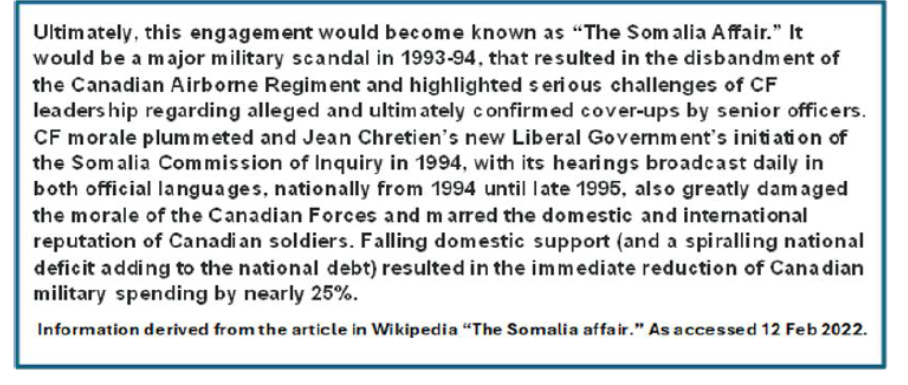
Unfortunately, public support of the CF in the mid-1990s was vastly different than it was at the beginning of the 1990s. A review of Canada’s military history in the first half of the 1990s, reveals that we (the CF, and the Navy in particular) started the decade with our high profile participation in the very successful coalition military operations led by the US against Iraq under Saddam Hussein and the invasion of his Republican Guards of Kuwait August 2, 1990. Given Canada’s prominent role in that conflict, the government of Prime Minister Brian Mulroney was asked to consider another military “stabilization” peacekeeping opportunity in one of Africa’s poorest, mal-nourished and civil war-torn countries on the horn of Africa… Somalia. Let me “set the scene” as we were undergoing the training for and during FREDDY’s conduct of this deployment.
In June 1995, there was an undercurrent of unease regarding how well the lower ranks would be supported by their superiors. Somalia had proven that there was malfeasance by some individuals within the offices of some very senior officers to hide the truth and the facts about the disasters of Somalia. There was a sense on the part of some people that it was only the ones on the lower rungs of the hierarchical ladder that were going to suffer if something went awry. According to the ‘media’ there was a “crisis of confidence” in the senior leadership of the CF.
In consideration of the foregoing, I developed my own table for the application of progressive force by HMCS FREDERICTON. Once we had gotten past the stage of firing warning shots ahead of a vessel by .50 cal Heavy Machine Guns and then the 57 mm cannon, I was going to be the first one to fire non-disabling shots at the offending ship. In essence, if something went wrong or there were problems then I would be the one to shoulder the consequences. I didn’t broadcast my intent before we sailed. What I had done was to practice my marksmanship with the 5.62 rifles that was kept locked up on the bridge when we were at sea. One day during our various sea trials in August, one of the electricians came to the bridge with a box of burned-out light bulbs and asked the OOW if he could throw them overboard. I asked him how he was going to make sure that they sank. He said he’d break them in the box and chuck them overboard.
I said “Not so fast. I’d like to use them as target practice for the rifle.” So, I got the bosuns to bring me up a couple of magazines and with the electrician standing close to
the front of the bridge house and out of the line of fire, he started to throw light bulbs out as far as he could, and I’d take aim and shoot. This gave me the idea of how I could take the first shots. If I were to take out their satellite communications, the ship’s Captain would have to think on his feet about the safety of his ship and crew without being able to seek direction from his agents ashore.
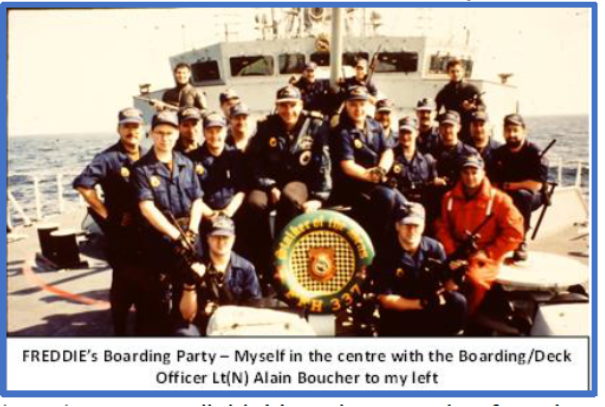
Satellite communications and radar antennae at 100 feet away, are a lot bigger and more stable than light bulbs, empty glass and salad dressing jars thrown 50 to 80 feet out from the ship’s side, bouncing up and down in the sea when we were underway at 8 to 12 knots. I began to practice whenever suitable targets were available! In only a couple of weeks, I had become a pretty good shot! Indeed, the boarding officer, Lt(N) Alain Boucher, challenged me to a target shoot off of the flight deck. I don’t recall the details, just that I won firing the rifle!! For the 9mm pistol, however, “the barn door was still pretty safe!”
We arrived in the Royal Navy Dockyard Gibraltar early on 7 December and completed the preps to receive the NATO/SNFL pack-up kit from HMCS VILLE DE QUEBEC
(VDQ) who would be arriving the next day. We opened the brow for non-duty personnel once the departments had confirmed that they were as prepared as possible.
The morale seemed to be universally positive. I had a junior squadron Chaplin on board who had joined us for our transit from Halifax to Gibraltar to check up on some of the far-flung members “of his flock”. Following dinner, he came to give me his assessment of how morale was in the three messes (Officers, Chiefs & Petty Officers, and the Master Seaman & Below Mess) before he returned to Halifax. He happily reported that morale was universally very high throughout. I thanked him but I also gave him some feedback for his personal and professional ‘growth.’
The perspective I highlighted was that he had spoken to virtually every member of my entire Ship’s Company – about their mental state; how they were faring; any
observations they wished to raise; etc. In fact, I noted that the only person he had not engaged was, myself. I pointed out that everybody else onboard has mates, friends, or colleagues with similar levels of responsibility with whom they could confide in or share personal frustrations or challenges. Ships’ Captains have no-one. Unlike my Army brethren, Lieutenant Colonels commanding at similar levels of responsibilities, have other LCols of different branches (infantry, artillery, communications, engineers, etc.) that they can frequently interact with face-to-face during operations on and off of the battlefield. Ship’s Captains can only find “like camaraderie” with other ship’s Captains, but one has to be circumspect about the subjects they talk about when dealing with foreign officers. Bottom line for the Chaplin, don’t forget the ‘Old Man!’
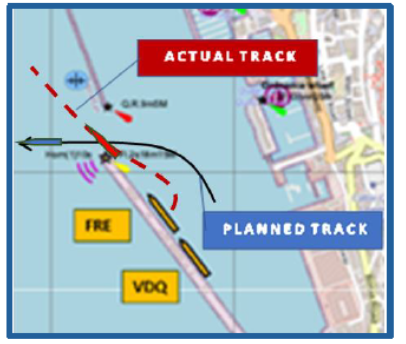
With the transfer of the NATO Packup complete, we officially joined NATO’s Standing Naval Force Atlantic (SNFL) in OP SHARP GUARD on 9 December 1995. On the 11th, we embarked the Gibraltar Harbour pilot, and we were assisted by a tug to exit the harbour. The entrance between the end of the jetty where we had been tied up and the breakwater that protected the inner harbour was about 200 metres wide.
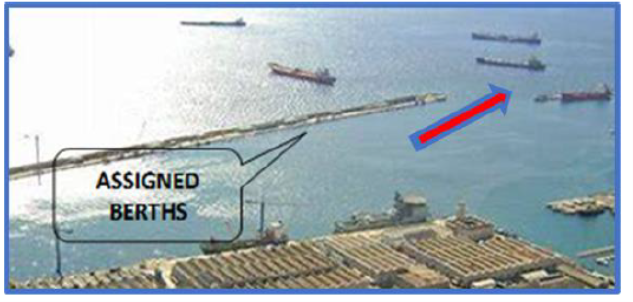
Shortly after we closed up and had singled up all lines, the winds suddenly climbed to about 50 knots and a cold driving rain that came from the port side. We let go all lines and were quickly blown off the jetty. I ordered 25 knots ahead both engines and put 15 degrees of port helm on. As it was, we “crabbed” our 135 meters length out of the 200-metre opening to the harbour and then the pilot demanded to be let off. That I was heading into an anchorage where there must have been 20 ships all at long stays of their anchors was of little concern to the pilot. We were out of his harbour, and he wanted off! He called the tug to come and get him and so I had to slow
down to about 10 knots which made extracting myself out of this mess even more challenging. On top of all of this, there was some guy in a small wooden rowboat about 500 yards fine on the starboard bow rowing like mad into the waves that had just sprung up! Just another day at the office!
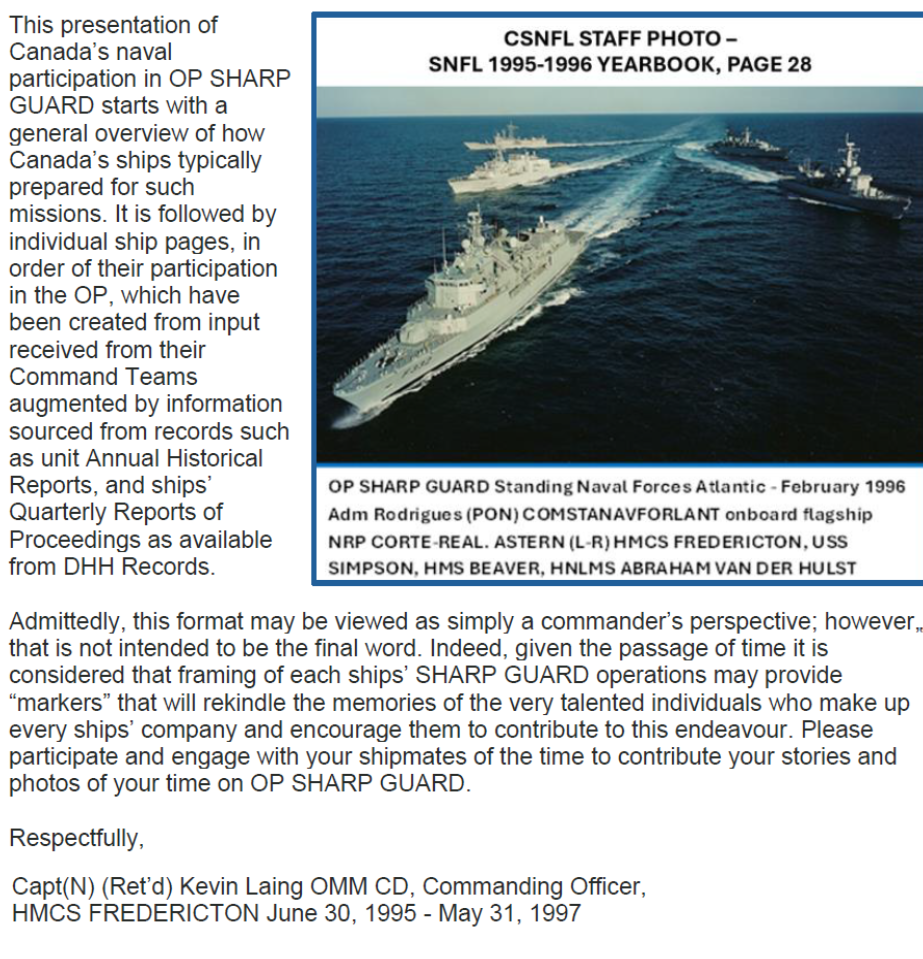
We were due to show up in the OP AREA in the Adriatic Sea at 0900 on December the 14th to conduct a day of familiarization with CSNFL Rear Admiral Rodrigues, (PON) and some of his staff. I recalled that each member of the crew would start collecting about $8 a day extra once we were in the geographically defined OP AREA. I asked the NavO, Lt(N) Clark Patterson, to calculate what speed we required to arrive in the OP AREA not later than (NLT) 2345Z on the 13th. I then asked the engineer, LCdr Marc Batsford, if there were any engineering trials or fuel consumption runs which required us to run at 25 knots over say 24 hours? Amazingly (wink, wink, nudge, nudge), he had a couple of trials he could run! And so off we went! We crossed the OP AREA activation boundary at 2330Z on the 13th, and I sent an immediate message back to Halifax to say that we had arrived in the designated “Active” patrol area on 13 December 1995.
For a few thousand dollars of the Queen’s gas, the troops got an extra $8 each! At 0900 14 December we rendezvoused with HMS Beaver which was acting as an alternate flagship for CSNFL, Portuguese Rear Admiral, Alexandre R. Rodrigues. We had a practice boarding on USS SIMPSON (FFG 56) and we were certified that
afternoon. Our first boarding came that night, in total darkness and two-meter seas. We succeeded very well. We spent the next week on patrol in our assigned areas and conducted numerous ship interdictions by voice and about a dozen more boardings.
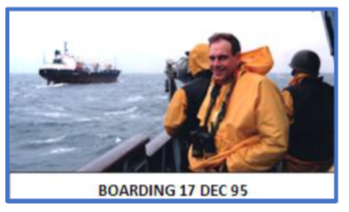
Here in this photo is one of the first boardings we did on 17 December 95.
On 19 December, I was advised by message that HMCS FREDERICTON had been awarded the Chief of Defence Staff (CDS) Unit Commendation for her performance during IDEX and her assistance to the British yacht the LONGO BARDA the previous spring. I was, of course, delighted to report this news to the Ship’s Company even though many of us were not affiliated with FREDDIE when these deeds were done! I greatly appreciated RAdm Garnett’s comments of our “short but already well-established history of distinguished service.”
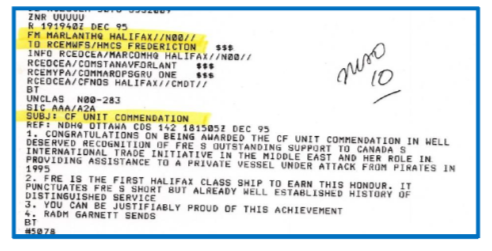
We arrived in Trieste, Italy in company with HMS BEAVER and NRP CORTE DE REAL on the 22nd of December. FREDERICTON hosted a very successful luncheon on
behalf of RAdm Rodrigues for himself, Cdr Jones of BEAVER, Cdr Gomes of NRP Corte De Real, COMPARE RAdm Sergio Albanes, ITCG, and several persons from the
local city and province. We also had a lot of inter-ship activity on the 23rd and 24. On the 24th, we met with the International Red Cross and turned over the 2,000 pounds of clothing that had been donated by the citizens of Halifax for delivery to the people of Sarajevo. We also donated food which was most appreciated.
For Saint Nicholas’ day, we kept the actual celebration of Christmas pretty much onboard FREDDIE amongst the FREDDIE Family! Of course, some of the major
activities related to a gift exchange; my switching places with the youngest sailor as the CO for the day (or a portion thereof); the new CO’s “Rounds” (aided and abetted by the XO and Cox’n); then the Christmas dinner where the officers and Chiefs and Petty Officers, served the troops and the carolling amongst the messes with the odd libation of well fortified Egg Nog and “Moose Milk” to improve our rusty and crusty vocal cords!
A gift exchange was held within each of the messes and there was an additional delivery by one of Good Saint Nick’s Irving “cousins” who happened to have found Mrs.
Irving’s ship and delivered a few large boxes of Ganong chocolates (an Irving company) sufficient so that every member of the ships company got a gift box of chocolate along with a Christmas card signed by Mrs. Irving herself! I was very touched by this. It further cemented the relationship which I felt with Mrs. Jean Irving as the ship’s sponsor.
We had a great talent and entertainment show put on by some of the more talented members of the ship’s crew. I reported that the hangar was jammed to the “roof tops.” I was quite sure that we met our Command Team’s objective of ensuring that there was such a full program of activities that there was little opportunity for anybody to sit down and ’mope’ about not being with their own family. All-in-all, a pretty good way to spend a Christmas with 240 of your closest friends!
Following Christmas in Trieste, we slipped and proceeded on the 26th and headed back to the OP SHARP GUARD patrol areas where we recommenced our patrol, hailing and boarding activities. During our patrol operations in the post-1995 XMAS and post 1996 New Year’s,
FREDERICTON had the unique distinction of being the last RAS customer for the huge USS oiler the USS MONONGAHELA in 1995 and her first in 1996! She was the biggest oiler that I had ever refuelled from at sea!
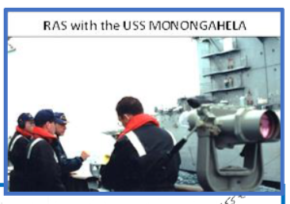
USS MONONGAHELA confirmed our status by a Press Release to her HQ with the following message:
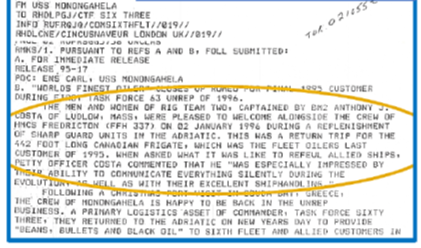
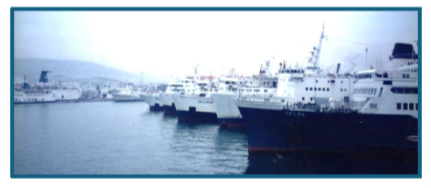
Following our refuelling from the USS MONONGAHELA on the 2nd of January, we turned over our patrol duties and headed off to Piraeus Greece which was our R&R port with no official scheduled functions! Piraeus is the port for Athens and only 40 minutes away from downtown public rail transit. Here our Commonwealth buddy, HMS BEAVER, would arrive 2 days later and was berthed not too far from us. The harbour was rather small, and it was clogged with dozens of ferries that were “Med-moored” to the jetty ready to embark passengers and vehicles.
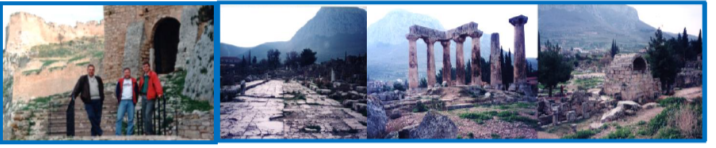
The XO, Combat Officer and I went out to do some sight-seeing which, as the XO succinctly observed, “as going from one pile of rocks to another pile of rocks!”
We left Piraeus on the 9th of January and proceeded to Naples arriving on the 10th. This was a single ship visit, and we were able to co-host an all-ranks reception with the staff of the Canadian Liaison Office, Headquarters Allied Forces Southern Europe in Naples on Thursday the 11th of January. We followed this up with special tours for AFSOUTH and Canadian Embassy staff on the Saturday morning. On the final day in Naples, I visited Pompeii. I was very impressed in 1995, and I believe that there has been substantial archeological work conducted since then to uncover more of Pompeii’s secrets! This is one place I would really like to return to!
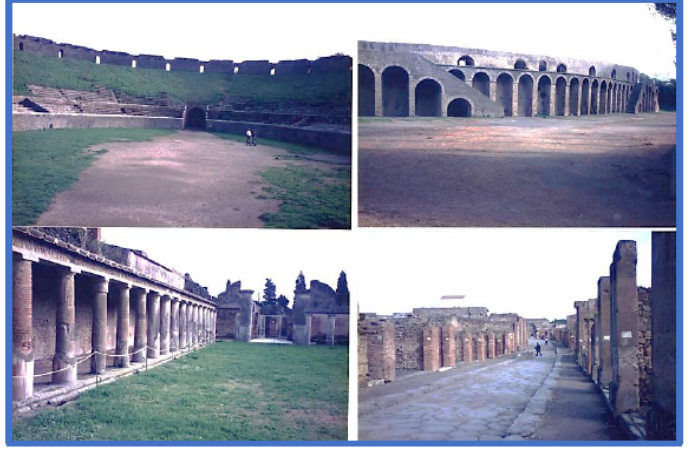
We sailed from Naples on January 16th and proceeded south for our third transit of the busy Straits of Messina. CSNFL was now authorized to proceed to the Western
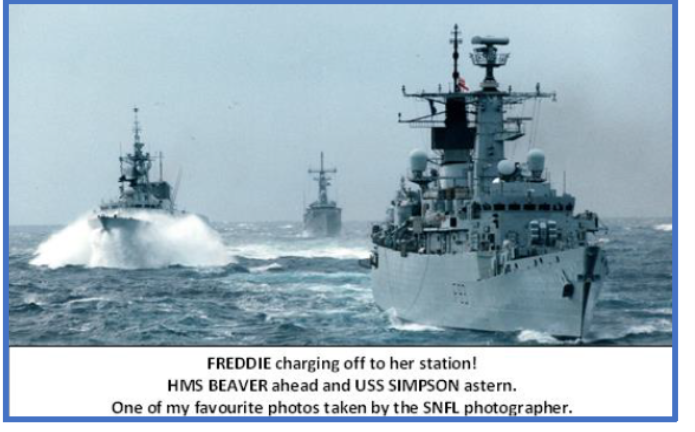
Mediterranean with his assigned five ships and conduct multi-ship evolutions including ASW with Italian submarines, Air Defence exercises and gun shoots, Officer of the Watch manoeuvres, replenishments at sea, and damage control, towing and search and rescue exercises. We ended up joining with a force of 9 other ships on the 17th to conduct a few days of very busy training scenarios, endless shiphandling manoeuvres, and Photo Exercises where we were maneuvering in very tight close quarters. I noted in a family “newsletter” that due to these exciting manoeuvres I was now low on MAALOX & VALIUM!
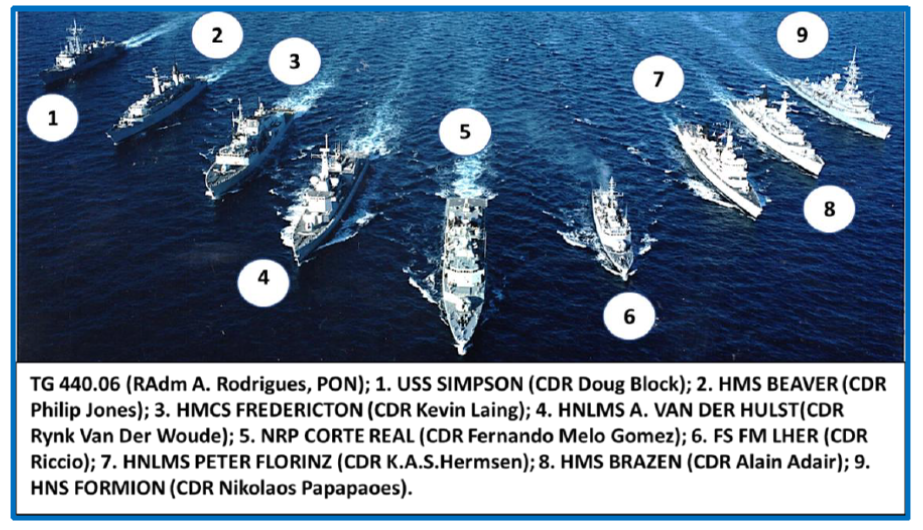
For a Damage Control exercise, I was tasked to simulate having a collision with USS SIMPSON by going dead in the water and then two ships would come up on either side to assist. I thought this to be rather “lame” and so I called up the skipper of SIMPSON, Cdr Doug Block and explained how I was going to generate the exercise. He was very keen on my approach. We were steaming on parallel courses at about 10 knots with maybe 200 yards between us. I cranked on some knots and then passed close ahead of him, again about 200 yards, then sounded the emergency alarms and piped over the ship’s broadcast and upper deck loudspeakers “Brace for collision!” We then dropped half a dozen explosive pyrotechnics5 that exploded underwater and simultaneously let off a dozen or so smoke bombs on the upper decks and stopped dead in the water sounding alarms for fire, floods, and damage control situations. We simulated having four fires, flooding and shoring plus eight casualties. We received assistance from two ships to receive fire fighting and damage control equipment plus personnel transfers, and the Portuguese helo evacuated one of our casualties. It was a great exercise!
Sound Underwater Signal (SUS) Charges. Signal charges used to pass simple communications to submarines and also as deterrents to hostile divers closing the ship.
We finished that training period and had our first SNFL Squadron port visit in Valencia, Spain arriving on January 25th. As this was the first “Squadron” port visit, the crews were kept very occupied by meetings between the responsible members on the Commander’s Squadron Staff with the various ship’s representatives for a host of activities like sports, entertainment, chef’s challenges, public affairs in addition to meetings between department heads of the ships’ engineering, supply, deck, combat and operations departments. Opportunities for the ship’s companies to socialize were important as that is where one gained a good appreciation of how you can best work collectively. Sports days in particular were excellent times for the ship’s companies to mix.
The Squadron’s Ships were Open To Visitors (SOTV) on Sunday the 28th of January 1996. Several thousand folks took the time to see the ships. FREDERICTON’s total came to about 1500, which was well below my experience from HALIFAX’s SOTV during our Great Lakes Cruise following her 1992 commissioning. The principal take-away, however, was that FREDERICTON was the first Canadian warship to visit a Spanish port following the “Turbot War” between Canada and Spain the preceding spring. The sailors gave the port visit to Valencia a big thumbs up as they found it to be the cleanest city that they had visited thus far.
We sailed on January the 29th for another few days of jam-packed exercises before arriving at Palma de Mallorca for a visit from 1-5 February. One of the primary items of interest for the sailors was shopping for pearl gifts for wives, mothers, and sweethearts. Mallorca is well-known for its man-made pearls which are virtually indistinguishable from genuine pearls. This shopping opportunity was most appropriate for the roughly one third of the ship’s company that were planning on returning to Halifax as part of the Leave Travel Assistance (LTA) opportunity. A flight had been organized for us upon our arrival at our next port of Souda Bay in Crete on the 8th of February.
We completed more SNFL squadron exercises on 5-6 February and then we headed off to Souda Bay to meet the 8 February LTA. As we headed east, the squadron would do some Anti-Submarine Warfare exercises with an Italian submarine. We took the shortest route steering due east (090) to pass north of Sicily and then southbound through the Straits of Messina which we had already traversed a few times in this deployment. We set our speed to 25 knots to drive down our required speed in the advent of any weather challenges later on. We’d then angle around the tip of the toe of the Italian “boot” and then head southeasterly to Crete.
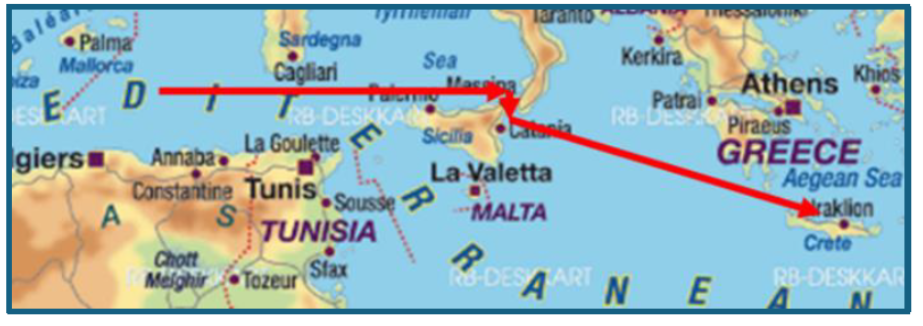
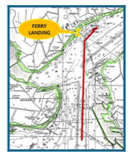
Sunset had occurred when we made our turn to starboard to go southward through the Straits. Going through the Straits at night wasn’t necessarily a bad thing. There was less chance of small boats complicating the picture. In addition to the north and southbound traffic, one also had to contend with fairly sizable ferries that crossed the straits in both directions. At its narrowest point, between Torre Faro and Villa San Giovanni, it is 3.1 km (1.9 miles) wide. With radar and good visibility, it was merely a question of finding the opening and “shooting the gap” at speed. For this, I elected to close up the SSD teams and come up on both gas turbines. I think that we made the turn to course 240o at about 10-12 knots and then looked for an opening to develop. One could find one by aiming at the stern light of a crossing vessel and ramping up to 25 knots on both gas turbines! Great excitement! The beauty of it was once you got to where the stern light had been 5 minutes before he’s long gone. The purpose of going to 25 knots was to confirm to other vessels that you meant business, and they would avoid crossing ahead of you. That’s the theory and it worked as it should! We got through the gap and headed southbound with only a couple of small contacts of concern ahead…and then the world went to **it!
I’ve included this ‘map’ to ‘situate’ yourself and to give you the context so you can appreciate how one seemingly “innocent” action illustrated the life of an Officer of the Watch (OOW): 95% boredom, 5% sheer terror! What followed was one of those “There by the Grace of God” points in my life.
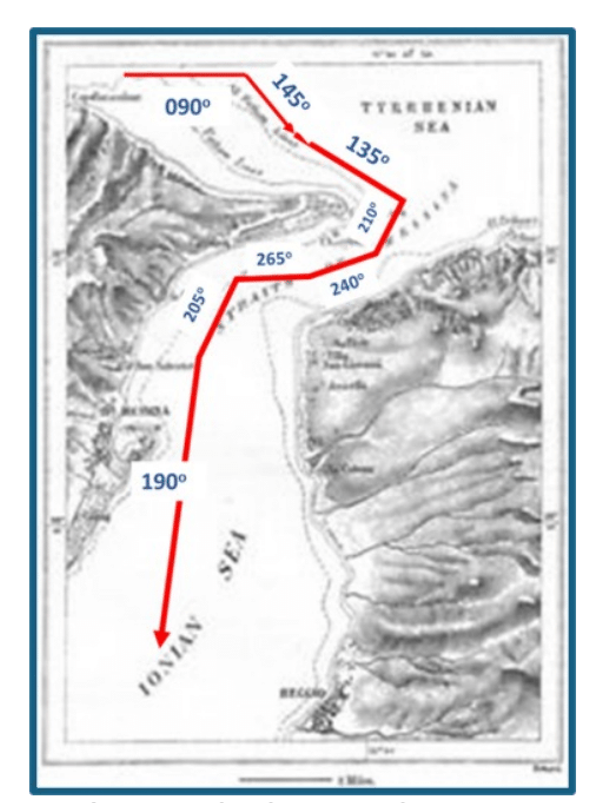
About five hours earlier we were heading due East on course 090o as we passed north of Sicily. The CPF has the ability to go on ‘Autopilot’ where the helmsman sets the desired course on the digital ‘counter’ at the helmsman position. This function is normally only engaged on long, open-ocean transits, and only when so ordered by the OOW.
Some of the helmsmen used the digital counter to remind them of the course they’ve been ordered to steer. As noted, about an hour before arriving at the north entrance of Messina we closed up the Special Sea Dutymen (SSD) and brought both engines up and available for full power. The process of assuming full power or switching back to a lower propulsion configuration required the Machinery Control Room (MCR) to take control of the engines for approximately 5 minutes. Changes to speed could still be done, however, there were delays which could slow the process should an emergency arise. Yup…stand by for heavy rolling!
As we cleared the southern entrance of the straits we were steaming at 25 knots on two gas turbines. The ship could do 25 knots on one gas turbine which would save fuel, but at the expense of a momentary (5 minutes) loss of control of the engines. In my immediate vicinity we had two contacts: one to starboard at about a mile and a half which had a Closest Point of Approach (CPA) that would pass at about 600 yards down our starboard side. I was steering a course of 187o to avoid this vessel, but remaining on 187o would cause problems with the second vessel which was at range of about 5nm with a CPA of 200 yards or less. Once we cleared the vessel to starboard, I altered course slightly to starboard to 190o which would have us clear this other vessel by 750 yards to port which I judged was suitable for the restricted waters and other traffic considerations.
This vessel was fairly small and only had a single white masthead light that I could see. My rough diagram at right is a representation of the view through the bridge windows in the upper part and a schematic representing a simple radar display below.
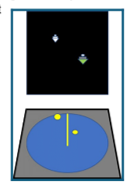
It was nearing midnight after a long day. My intention was to remain on the bridge until we passed the second contact and then head below for some sleep. The OOW asked, “Captain, Sir, now that we’re clear of the Straits would you like to revert to one gas turbine, cross-connected?”
I replied, “Not yet. I’ll wait until we get clear of this contact.” The contact was about 4 miles, and we’d be clear of him in about 7 or 8 minutes or so. “Very well Sir. Request that we secure SSD and close-up the regular watch.”
“Yeah, that’s fine.”
The pipes were made, and personnel started the watch turnover. I remained in my chair with my message log in hand. There was just this one contact ahead. I heard the
Helmsman report to the OOW, “OOW, Sir, helmsman relieved by Able Seaman Bloggins,6 steering course 190, both engines half ahead, speed 25 set, Sir!”
“Very Well.”
The night was very dark, and the shore lights of Sicily and Italy were retreating but were still quite distinct in clear visibility. This is what saved us. The lights ashore to starboard were starting to move to the right! I looked up at the course gyro tape repeater and noted that the ships head was 188o and we had 10 degrees of port helm on.
I ordered “OOW, Helmsman, watch your helm!” We were turning to port at 25 knots, and the contact ahead was now less than 800 yards! As I had addressed the helmsman directly, I had the Conn!
“Midships! Starboard 30!”
“Stop Starboard, Full speed astern starboard!
The helmsman shouted, “Ship does not answer the helm, Sir!”
“Stop Port! Full speed astern Port!”
“Officer of the Watch sound six short blasts!” Make the pipe for “Steering gear breakdown.”
“Signalman, switch Masthead lights to “NUC” (Not Under Command) and get on channel 16 for a Securité call to advise ships in our area.”
In about 30 agonizing seconds, the rate of turn slowed, and the ship stopped. From my vantage point centreline on the bridge, I looked ahead. There, through the bullring on the bow I saw the dim silhouette of a submarine on the surface, less than 200 yards away. She was silently slipping by, seemingly oblivious of our escape from catastrophe.
We continued to use secondary steering until the EO could confirm the state of the primary system. I think that I had a few cigarettes on the port bridge wing as I watched the submarine disappear into the night…fortunately, unharmed, and still on the surface! We still needed to make good time to get to Souda Bay so the lucky third of the ship’s company could catch their LTA flights home. As we were now stopped, I gave the OOW the permission to reconfigure the engines to a single gas turbine. My call to keep control of the engines on the bridge until we passed that small contact was key to our survival!
I was still on the Bridge when the EO, with the XO and Cox’n, came to give me their assessment of the steering gear breakdown. Apparently, there was no breakdown! The 6 “Bloggins” was not an individual per se; it is merely a concocted name that naval types use as a subject personage. Normally a junior enlisted person but could be any rank depending upon the story being told!
The system did what it was told to do. Remember I mentioned that some sailors liked to set the autopilot readout to remind them of the course they were steering? The last course where this had been used was when we were north of Sicily sailing due East (090o). When the SSD watch was stood down and the regular watch came up to the Bridge, the Helmsman reported that he was steering course 190o. That lasted for a minute when he figured he would engage the autopilot which he thought was set to 190o when it was actually set on 090o. So, when he engaged the autopilot, the ship’s steering system said “Okay” and applied 10 degrees of port helm to bring us to 090o. It did what it was told to do. It was the person who engaged the autopilot without authority who was in the wrong!
The XO and the Cox’n were accompanying the EO because this sailor had broken the rules. By so doing, he had endangered the ship! The Cox’n was ready to have the individual charged with Purposely Endangering the Ship, the penalty for which in wartime could include death. I doubted that AB Bloggins went on watch with any intent to do damage. More than likely, he was just lazy and had pushed autopilot button because he thought that was marked on its counter and that he could get away with it.
One of the most interesting things that we did find out through our investigation on the ship and through Fleet School Halifax, was that nowhere in the training documents for the various naval trades which had Helmsman as one of their associated duties did it say, “Thou shall not engage the autopilot without order by the OOW.” Somehow the officer crowd had gotten into our collective brainboxes that “As it is written and so It shall be.” But we found it wasn’t written so we couldn’t prove that the troops had been so instructed.
The most egregious offence that I thought that we could get him for was negligence of duty which may have had Courts Martial implications. As previously noted, this could drag on with the result that justice is not seen to be done by those who were there. I sought out legal advice from Halifax on the type of charge which might be most appropriate. I believe that we settled on the old standby “Conduct Prejudice to Good Order and Discipline.” The other interesting wrinkle was that as I was a witness, I could not adjudicate the case. I assigned my powers of punishment to the XO and named him as the next Superior Officer. Somehow it all got worked out and I believe that “The guilty bastard was marched in, given 14 days confined to ship, and a $1000 fine.”
Of the event itself, I completed a Critical Incidence Report message back to Capt(N) Mackay, COMMARGRUONE where I gave a succinct, but detailed report of everything that had transpired. One of the key elements of concern was that I was unable to disengage the autopilot. He in turn gave my message to CO HALIFAX, who was doing some local area day sailing. Cdr Sweeny did exactly what I reported. He later said he felt that he was right there beside me and he was sitting on the edge of his seat! He found out that the only way to disengage the autopilot was to turn the helm all the way to the stops. This was an American designed system. The USN uses different terminology for ship handling - like “Right/Left Full Rudder.” Full rudder on the CPF is 38o to port or starboard. We never say, “Full Rudder” or “Starboard 38.” We say starboard 35. What difference could a couple of degrees bring? Apparently, lots!
I also sent an email to CSNFL as I believe that the submarine I almost about took out was perhaps the one coming to exercise with the rest of the SNFL ships. I don’t think that I really got any feedback from CSNFL, nor did I really hear too much about that event afterwards.
So here it is now February 7th, and we were trying to proceed at speed to meet the LTA requirements for the 8th; however, Mother Nature gave us some very rough weather as we crossed the Ionian Sea enroute to Crete. We had to slow down to about 12-14 knots after we took damage to some stanchions and the port breezeway door. Damage was also done to our bridge-top spotlight and some other equipment. We kept our speed down to minimize damage but as conditions started to improve, we started cranking on the knots. On the morning of the 8th, we cranked up both gas turbines to drive down the speed required to about 20 knots. We arrived at the NATO refuelling jetty in Souda Bay early afternoon, but the Greek tugs were taking forever to get us alongside so the folks could leave. The departees had just enough time to grab a box lunch and then hoof it up to the buses which were not allowed on the refuelling jetty. I think that both Ken and the Cox’n got away for a week before they returned.
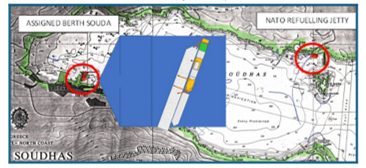
On the 9th, we did a hot move from the refuelling jetty to our assigned berth in Souda. We sent a recce team over to check out the berth and launched our Rhib with a few lads who could act as both an improvised tug and berthing party. We had to take a pilot and accept the offer of tugs. The facilities in 1996 look nothing like what appears to be available today. We were in Souda Bay until the 21st of February.
This chart and the diagram of the berthing arrangements shows where the bollards were and how we secured ourselves. It comes from information that I had recorded in my small binder of Command Board situations for testing future Captains should I be asked to participate in Command Boards.
I’ve always been amazed at the resourcefulness and ingenuity of Canadian sailors. In this case it dealt with the buckled port breezeway door that we suffered in the last
couple of days transit to Souda. We rented a crane on a truck so that we could move the brow as required and also for shifting material to and from the jetty. Once the brow was in place, the engineers had the crane move along the jetty until it was by the foc’sle. They then used the crane to remove the two buckled breezeway doors (each about a thousand pounds) and place them on the concrete jetty. They then manoeuvred the crane such that the hydraulic stabilizers used to lift and stabilize the crane while in operation were over the bent doors and used the truck’s hydraulics to push out the dents and straighten the doors.
At the end, with a bit of paint, the doors looked as good as new! Way to go team!
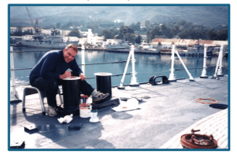
I chose not to pursue any LTA funded travel. My duty as Captain was with my ship. I could not fathom being several time zones away from her while I was in Command. I was blessed that Lynn understood my thinking. As much as I would have liked her to come and join me, I completely understood and accepted that her first duty was to take care of the home front. However, the “Buffer” (Deck Department Chief Petty Officer) made sure that I was gainfully employed by painting a red maple leaf on the tops of all of the bollards on the foc’sle!
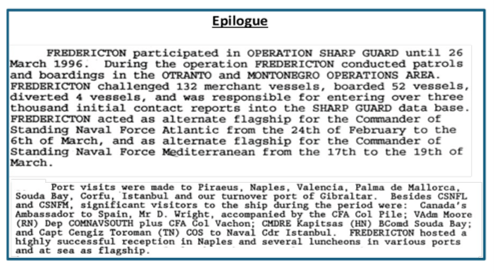
We sailed on the 21st and recommenced our OP SHARPGUARD patrol operations in the area on the 23rd. On the 24th, we welcomed RAdm Alexandre Rodriques (PON) and his staff as we assumed the duties of the Alternate Flagship so that the CORTE REAL could go into port for a leave and Self Maintenance Period (SMP) such as we had done in Souda. We were to undertake these duties until 5 March. This would be the busiest time of our entire deployment. Until now, we had conducted 16 boardings of potential violators. During these 11 days we would add another 34.
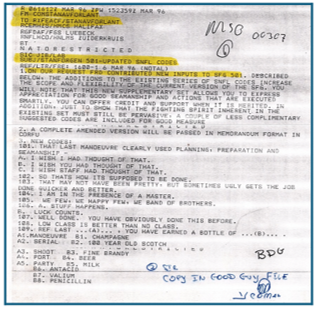
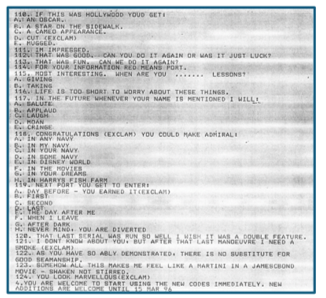
Given the Dayton Peace Accord, CSNFL anticipated that SNFL would soon return to “normal” squadron activities in the Atlantic theatre. Admiral Rodrigues had asked us, collectively, to think up ways to regenerate the more traditional SNFL spirit. You may have noticed that some of the messages between units within the Squadron have a paragraph that says simply SNFL CODE and then a number. These codes are normally sent in jest but some have a shred of truth in them and many were less than flattering. I had mentioned this to Admiral Rodrigues while he was onboard with us as his alternate flagship. He very much liked the idea and so with the assistance of the
Wardroom under the XO’s tutelage we drew up a list of 25 codes that we thought could fit the bill. I handed them to CSNFL as he was leaving to return to NRP CORTE REAL. I’m sure that he and Cdr Rick Towns (RCN) had the opportunity to study them in some detail as there were a couple of subtle changes changes from what we sent in my memo and what he promulgated as a change to the SNFL Standing Fleet Guide (SFG) later that day!
Our stint as the alternate flagship for CSNFL ended the 6th of March. With his and the his staff’s departure, we turned our bows east to the Greek island of Corfu which was at the northern end of mainland Greece near the entrance to the Adriatic and not far from the OP SHARP GUARD patrol areas. We arrived in Corfu, an R & R port, in the late afternoon of a beautiful sunny day with only a whisper of wind. This was a good thing because we had to berth outboard of HNLMS KAREL DOORMAN (KDM) a Dutch frigate whose freeboard (height of hull above the waterline) was much lower than ours…I’d guess about half the distance.
The flare of our hull could cause some damage to this ship’s stanchions and any equipment that was situated along the edge of the ship. My approach was spot on and we slid precisely into place with virtually no undo impact. The lines at Top Part Ship (Midships) were handed to the line handlers without having to toss the monkee’s fist and light messenger line first. I don’t believe that we had any official functions at all. I remember that the buildings along the shore were quite colourful, but as they were about a kilometre away I chose to remain onboard. I had lots of paperwork to do!
In his farewell message to us on 26 March he said that “You also left the force quite a legacy in your stay here. None of us can use a 100-series SNFL Code without remembering your authorship!” I don’t recall whether they got used or not in our next more traditional SNFL in ’96.
Using a pilot and two tugs to ensure that we did not lean or bear on KDM, we gently departed Corfu at 0700 on Friday, 8 March. Our next destination was the place where Europe meets Asia – Istanbul! This promised to be one of the most interesting ports in our entire deployment!
COMNAVSOUTH had arranged some aircraft from the Greek Air Force to support an Air Defence Exercise (ADEX) for us to the southwest of Greece. We got buzzed by a couple of aircraft. I was in the Ops Room and the XO was on the bridge. He called down to Ops and suggested that I come to the Bridge (bring a camera!) These pilots were crazy (like Crazy Canucks in snow sports!) One made an approach from astern and when he went by us at bridge level I could hear the Close-In Weapon System (CWIS) spin up to lock onto him, and he banked and we clearly saw inside of the cockpit. Another came by us from the starboard beam and he passed ahead of us at about the same distance as that Italian submarine-about 200 yards! We wound around the Greek islands and entered the Dardanelles Strait where we piped the side at various points to recognize official war cemeteries.
The entry to the Bospherus Straits which connects Istanbul to the Black Sea is at the eastern end of the Sea of Marmara. Even though our anchorage off of the Dolmabançe Palace in Istanbul was only about 5 miles into the Bosphorus Straits, the combination of heavy traffic, tricky currents, and requirement for local knowledge of the customs in these waters made the employment of a pilot an absolute neccessity.
The other factor was that the visibility had dropped considerably due to fairly heavy snow squalls. Our pilot, an affiable gentleman who enjoyed receiving our tokens of appreciation (a crest and ball cap). He provided excellent advice on what we might expect as we proceeded in the crowded traffic lanes. He was quite happy to use his radio to tell ships to get out of the way and I think that he had two tugs which he used more like CFL blockers for the half-back (us) to keep the plethora of small ships
out of the way. He mentioned to me that he had been the pilot for HMCS VILLE DE QUEBEC (VDQ) which he said was the last Canadian ship that had visited Istanbul in November of 1995. He asked me what was with Canadian warships? The last time it had snowed in Istanbul was when he brought VDQ in!
The visit to Istanbul did not disappoint. There were excellent museums, mosques, and galleries to explore. Exotic meals to be had in reasonably priced restaurants. “The Grand Bazaar in Istanbul is one of the largest and oldest covered markets in the world, with 61 covered streets and over 4,000 shops on a total area of 30,700 m², attracting between 250,000 and 400,000 visitors daily.”8 I was not immune to shopping in the Grand Bazaar! I spent at least two hours bargaining for leather coats for my son and I. We had tea, looked at several coats, and then haggled about the price. I left there with two leather coats for the price of just my coat! ($200USD) It was an interesting bazaar experience!
This description comes from “bazaar in Istanbul Turkey - Search (bing.com)” as accessed on 8 March 2022.
We sailed from Istanbul on Thursday, 14 March and returned to the OP SHARP GUARD patrol areas on the 16th where we received an urgent request from the Commander Standing Naval Forces Mediterranean (CSNFM), RAdm Roper, FGN, as to whether we could act as his alternate Flagship for a few days. Apparently, his alternate flagship had just suffered failures of their Link 11 and some other systems. We immediately cleared the request with CSNFL staff and said absolutely to Admiral Roper.
Our time with Admiral Roper was quite good. He was very interested in seeing the ship and talking to the sailors. We conducted 2 boardings while he was onboard. He attended one of the boarding party briefings when the team received the details of their target and the Rules of Engagement and any other last minute instructions. He then observed the execution of the boarding from the bridge. He was most impressed by all that he had seen.
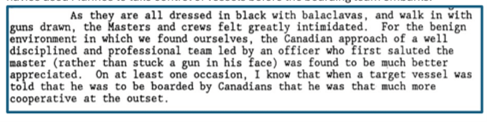
In my Report of Proceedings for the first quarter of 1996, I noted that our boarding team was well prepared and adequately equipped for this mission. In particular, both CSNFL & CSNFM considered that our RHIB was the best and most suitable one of the entire NATO fleets. Indeed, RAdm Roper remarked that he considered Canada’s approach to boardings for this phase of OP SHARP GUARD was the best. He noted that the Dutch and British navies used Marines to take control of vessels before the boarding team embarks.
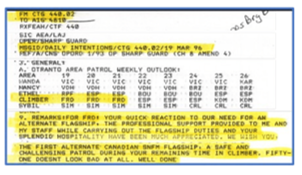
In one of the last messages received from Admiral Roper which assigned FREDDIE’s (FRD) final patrol areas, he again thanked us for our quick assumption of duties as his alternate flagship. He noted that we were the first Canadian warship to do so as part of STANAVFORMED!
Admittedly, the situation regarding boarding operations 30+ years after OP SHARPGUARD is not the same as it was in 1995-96. Now we are even more well-equipped and practiced in boarding operations given that we’re 25 years past 9-11 and the rise of terrorism at sea, on land, and in the air. Our entire fleet of CPF’s have had multiple deployments in the Middle East, or the Black Sea and another potential hot spot the South China Sea. Our MCDV’s have taken on significant roles on both the Pacific and Atlantic sides of the Panama Canal to intercept billions of dollars of narcotics and to prevent them from coming ashore in North America.
All I can say is “Well done the Boats’ Crews! Bravo Zulu!”
We arrived in Gibraltar on the 25th of March. HMCS HALIFAX, with my good friend Dave Sweeney in Command, would arrive later that day. I made a courtesy call upon the Governor of Gibraltar, Admiral Sir Hugo White. Admiral Garnett had mentioned to me previously that he and Sir White were compatriots, and so I was pleased to pass along Admiral Garnett’s compliments. I reported that the Governor was a most congenial individual! Unexpectedly, we spent almost a full hour for discussions and a personally guided tour of the Covent.
From there, it was back to the ship where the turnover of the SNFL pack to HALIFAX was in full swing. At 0001Z 26 March 1996, HMCS HALIFAX assumed the duties as Canada’s representative to the Standing Naval Force Atlantic in OP SHARP GUARD. She would leave later that day, and we would head home arriving in Halifax on 4 April 1996.
INPUT FROM FREDERICTON’S SHIP’s COMPANY
Have feedback or a story to share?


.jpg)