OP Sharp Guard 11 Dec 95 to 20 Mar 96, Capt (N) (Retired) Kevin Lang, CO of HMCS Fredericton
WARNING: Due to the nature of the conflict and operations in the Balkans, some of these veterans' stories may contain graphic or disturbing content. Please use your discretion. If a story adversely affects your mental health, consider seeking help by consulting the agencies listed in the Resources section of this website.
General outline (more detail to follow):
- Intro:
- • Brief overview of the OP SHARP GUARD Mission
- • Overview of RCN participants
- Individual Ships (in order of participation)
- Preps for the mission;
- o Mission Training, Teams/Ops trainer/Boarding Party/ROE
- o Equipment added (RAM pads), mine avoidance sonar, weapons
- o WUPs
- o Charity donations fm Canadians (FREDDIE delivered about a ton of clothing to the Red Cross during XMAS visit to Trieste in 95)
- • Joining SNFL (relief of HMCS ???/when/where)
- o SNFL PACKUP
- o CSNFL Staff embarked?
- • Operations - anything notable?
- o any scary ops?
- • ROE challenges
- • “ACTION STATIONS” for real i.e. FRY EW simulated attack profiles?
- • Boardings
- • Weather
- o Port visits
- o Significant visitors?
- o Stats - boardings, hails, diversions?
- • Ops during return home
- o Lessons Learned?
Operation SHARP GUARD
International Operation Name: Operation SHARP GUARD
International Operation Dates: 1993/06/15 – 1996/06/19
Mandating Organization: United Nations
Region Name: Europe
Location: Adriatic Sea
Canadian Operation Name: Operation SHARP GUARD
Canadian Operation Dates: : 1993/06/24 – 1996/05/16
Mission Mandate:
To enforce United Nations Security Council Resolutions embargoing imports into the Federal Republic of Yugoslavia (Serbia and Montenegro).
Mission Notes:
The degeneration of the political and military situation in the former Yugoslavia resulted in the United Nations creating the United Nations Protection Force in an attempt to moderate the situation in Bosnia-Herzegovina and Croatia. An arms embargo was also declared against the Federal Republic of Yugoslavia (FRY - Serbia and Montenegro) with the passing of Security Council Resolution 713 on 25 September 1991. Both the North Atlantic Treaty Organization (NATO) and the Western European Union (WEU) provided ships to enforce the embargo, while NATO also provided maritime patrol and airborne early warning aircraft. However, the resolution did not actually allow sufficient powers to halt any suspected violators, simply registering them.
The Security Council passed resolution 757 on 30 May 1992 that provided greater teeth to the enforcement of the embargo, and expanded the list to all items except foodstuffs and medicines. NATO and the WEU continued to provide ships, and the former aircraft to support their respective operations. On 17 April 1993, the Security Council passed Resolution 820, which prohibited all vessels from entering the territorial waters of the FRY. On 8 June, at a joint session of the North Atlantic Council and the WEU, the two organizations decided to combine their operations that were supporting the enforcement of the embargo against the FRY. The new operation was named Operation SHARP GUARD and came into effect on 15 June 1993.
Op SHARP GUARD consisted of two naval task forces – one from the WEU and one from NATO, operating under the name Combined Task Force 440. NATO's was based on the Standing Naval Force Atlantic (STANAVFORLANT) or Standing Naval Force Mediterranean (STANAVFORMED). They operated under a NATO operational control, augmented by WEU staff officers. NATO maritime patrol aircraft flew over the Mediterranean and Adriatic Seas to identify merchant vessels and generate a picture of where all ships were in the Adriatic. NATO Airborne Early Warning Aircraft provided a coordination and control function, identifying air and sea threats, and notifying the appropriate NATO vessel and the CTF 440 headquarters.
The ships deployed on Op SHARP GUARD operated right up to the 12 mile territorial limit of FRY waters. Albania had given permission for Op SHARP GUARD vessels to enter its territorial waters to conduct the enforcement. The ships were maintained at a high state of alert while operating off the FRY waters. The FRY had a navy that posed a considerable threat, including highly capable submarines. There were also land-based anti-shipping missiles and aircraft that could carry out anti-shipping strikes. On numerous occasions, FRY ships and aircraft conducted activities that could have been construed as hostile, including aircraft making what to all appearances were attack runs against the ships. Only the calm resolution of some ships' Captains prevented fire being opened against the offending FRY combatant.
After the signing of the Dayton Peace Accord in December 1995, events began to calm down in Bosnia-Herzegovina. The Security Council, noting that an agreement had been reached in Dayton, Ohio in November, agreed to lift the embargo in a phased process starting 90 days after the FRY had signed the agreement. Resolution 1021 was authorized on 22 November 1995. Security Council Resolution 1022 passed the same day lifted other aspects of sanctions imposed against the FRY and Bosnian Serbs. With the authorization of these two resolutions, Op SHARP GUARD began to wind down, finally terminating on 19 June 1996.
Canadian Mission Notes:
Canadian participation in Op SHARP GUARD also used that operations name and consisted of both naval and air forces. The initial response was to send HMCS Algonquin, which was then flagship of the Standing Naval Force Atlantic (STANAVFORLANT), to Op SHARP GUARD when NATO sent STANAVFORLANT to support the new operation on 8 June 1993. Algonquin was the first of 11 deployments, with two ships deploying twice.
The ships and dates for the operations with Op SHARP GUARD were:
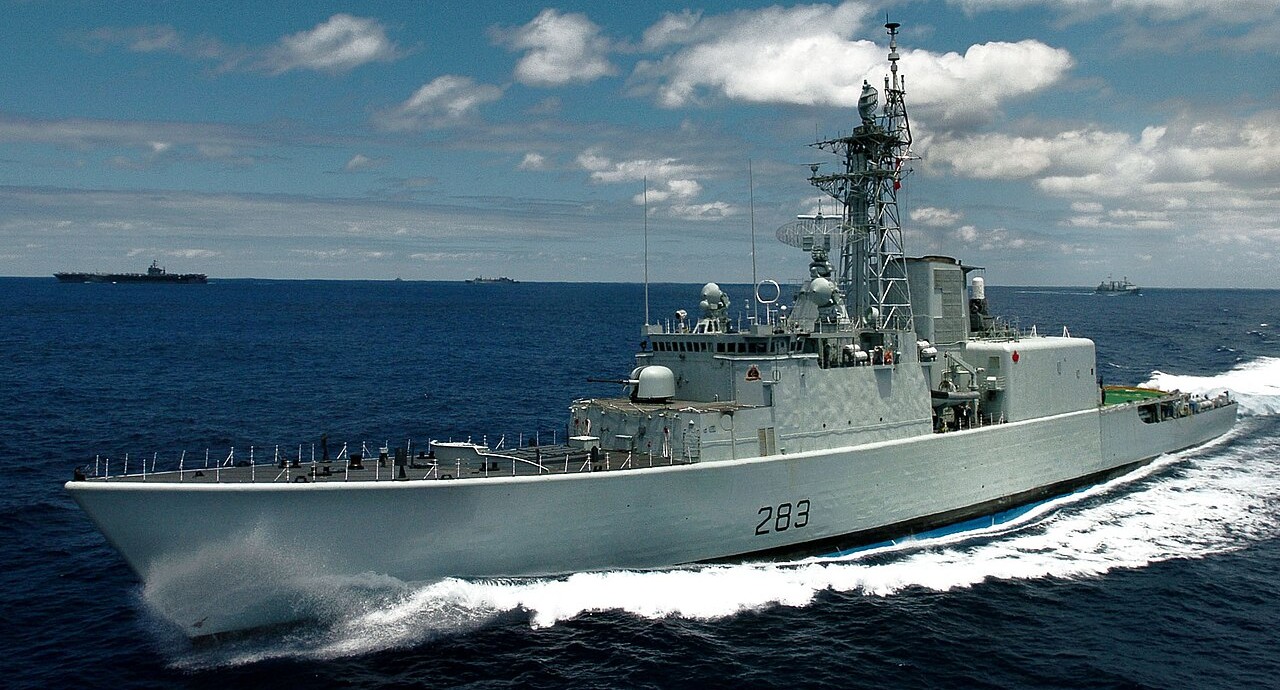
(U.S. Navy Photo by Photographer's Mate 2nd Class Jayme Pastoric)
HMCS Algonquin (DDG 283), 24 June to 3 October 1993.
_underway_1999.jpeg)
(U.S. Navy Photo by Photographer's Mate 1st Class Franklin Call)
HMCS Huron (DDG 281), 1993.
(Jim Henderson Photo)
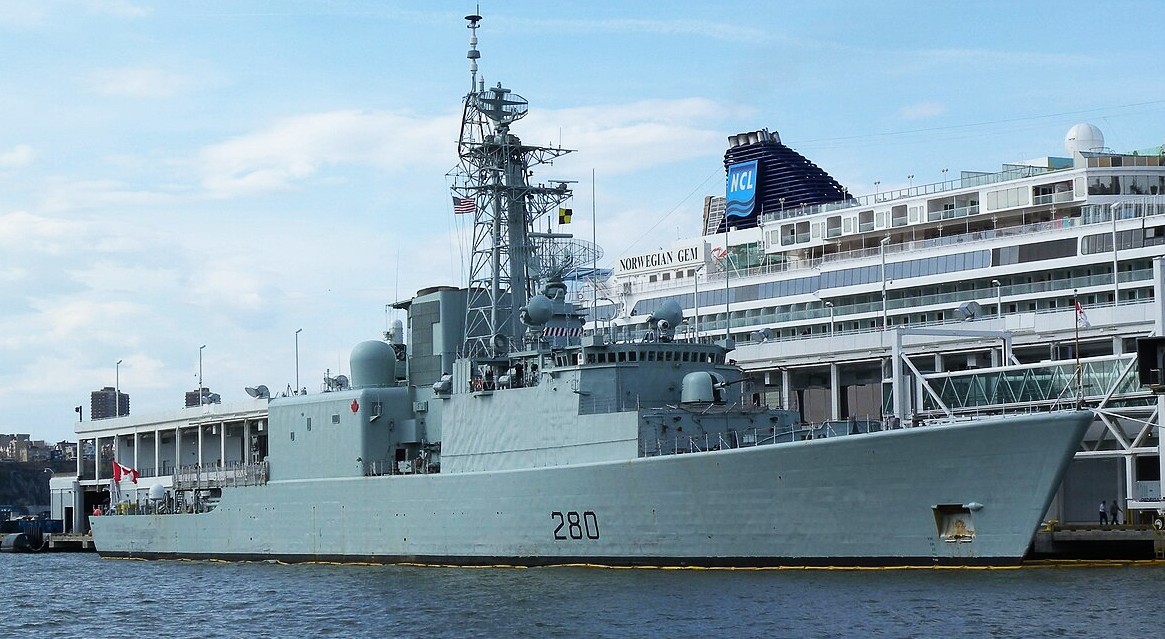
HMCS Iroquois (DDG 280), 7 October 1993 to 4 April 1994.
.jpg)
(USN Photo by Mass Communication Specialist Petty Officer 2nd Class Erica R. Gardner)
HMCS Preserver (AOR 510), 11 February to 27 May 1994.
_en_route_to_Haiti_2010-01-18%20(1).jpg)
(MC2 Kristopher Wilson, USN Photo)
HMCS Halifax (FFH 330), 18 April to 25 August 1994.
_3.jpg)
(U.S. Navy Photo by Photographer's Mate 1st Class Brien Aho)
HMCS Toronto (FFH 333), 5 September 1994 to 11 January 1995.
(Bruce Davidson Photo)
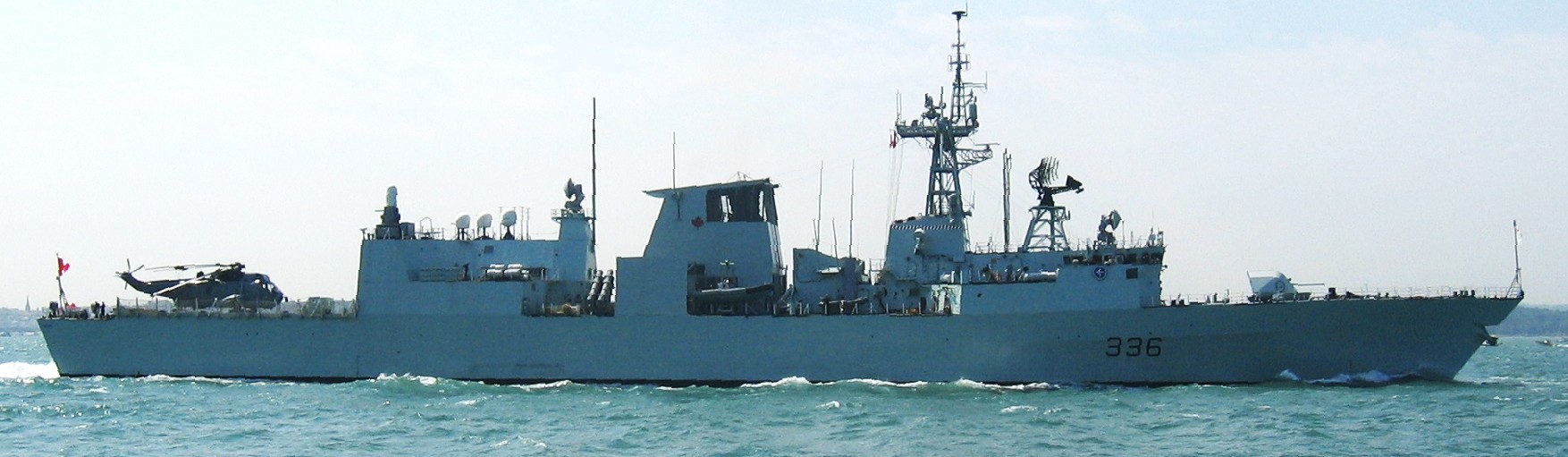
HMCS Montreal (FFH 336), 20 January to 8 July 1995.
HMCS Preserver (AOR 510), 27 March to 5 May 1995.
(RedAndr Photo)
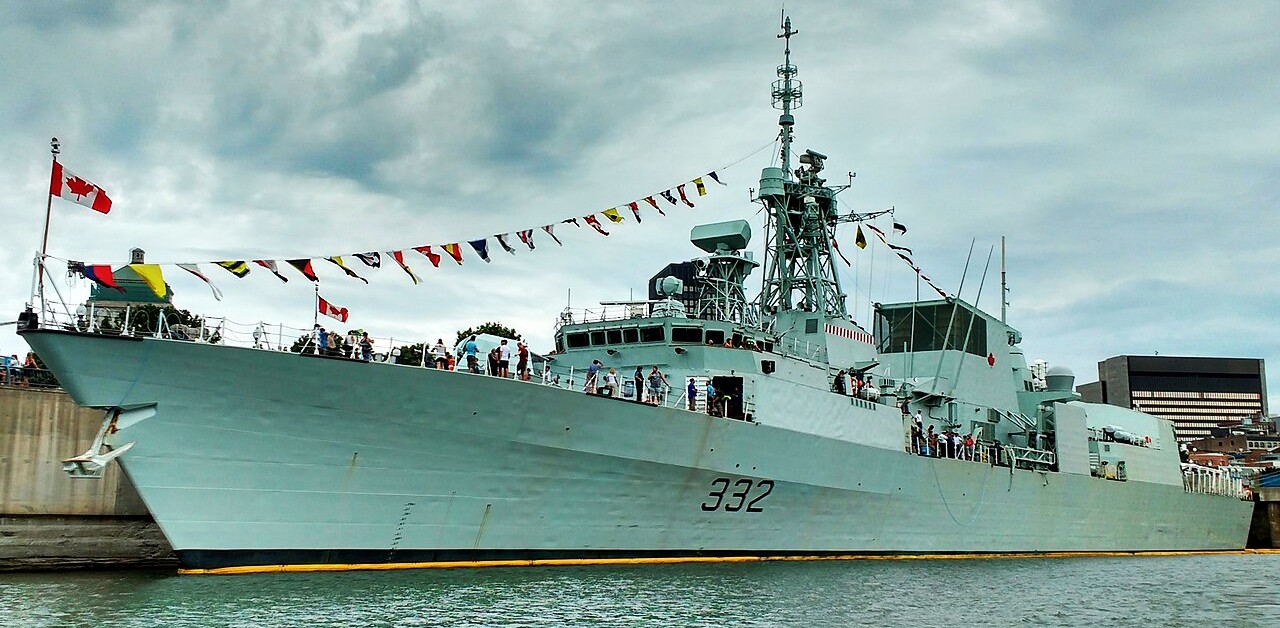
HMCS Ville de Québec 15 July to 8 December 1995.
_leaves_Pearl_Harbor_in_July_2014.JPG)
(U.S. Navy Photo by Canadian Armed Forces Sgt. Matthew McGregor)
HMCS Calgary (FFH 335), 25 October to 26 November 1995.
.JPG)
(Christopher R. Shrank, U.S. Navy Photo)
HMCS Fredericton (FFH 337), 11 December 1995 to 20 March 1996.
HMCS Halifax (FFH 330), 30 March to 15 May 1996.
Because of the capabilities of the Canadian ships, they normally found themselves in the forward operation areas closest to the FRY territorial waters. On occasion they came near harm’s way, having had a FRY aircraft conduct an attack run against one ship, and on other occasions being targeted by the FRY fire control radar. On another occasion, a Canadian warship interposed itself between a FRY warship and a fishing vessel that it had attacked.
More significantly, the Canadian warships conducted hundreds of hailings and over 100 boardings and inspections of vessels resulting in about a dozen vessels being diverted to Italian ports for more detailed inspections. These boardings normally involved bringing a rigid hull inflatable boat (similar to a zodiac) alongside the vessel, climb five or more stories up an often wet ladder, sometimes in heavy seas. The Canadian boarding party would then show every respect to the captain and crew of the merchant vessel while conducting the inspection. On occasion, the ship's helicopter was used to fly the boarding party to the vessel being inspected.
The Canadian warships normally deployed with an embarked CH-124 Sea King helicopter. Most of the Sea Kings were configured for anti-submarine warfare, which was a prudent consideration given the submarine capability of the FRY navy. They were also equipped with Forward-Looking Infra-Red and stabilized binoculars to allow search and identification of vessels at sea, as well having chaff, flares and missile warning systems. The Sea Kings thus extended the operational capability of the warships.
The Canadian Air Force provided a valuable contribution to Op SHARP GUARD beyond the Sea King helicopters deployed on HMC Ships. From August 1993 to May 1994, and again from May 1995 to September 1995, two CP-140 Auroras were deployed to Sigonella, Italy to conduct patrol flights over the Mediterranean and the Adriatic. The flights over the Adriatic were particularly challenging as they were within a few minutes flying time of any hostile FRY aircraft, with the Auroras being lit by fire control radar on occasion. Immediate evasive action was required on such events as it could indicate that a surface-to-air missile could be on the way. The Auroras flew at least one mission every day, each mission being 10 hours long. By conducting general reconnaissance flights and identifying vessels, the Auroras allowed commanders to build up a picture of the situation on the sea, and identify the location of potential embargo-runners.
Canadian Air Force personnel also served with the NATO Airborne Early Warning Force (NAEWF). The NAEWF, based in Geilenkirchen, Germany used Boeing E-3A Sentry aircraft to observe the air traffic over large areas of the Adriatic and the former Yugoslavia. The E-3s also provided a capability to coordinate the various resources that could respond to a threat or manage a situation. Every Sentry flight contained Canadian crew members.
The Canadian naval contribution to Op SHARP GUARD ended on 15 May 1996 when HMCS Halifax departed. The Air Force's Aurora contribution ended in September 1995. The personnel with the NAEWF flew missions until the end of the operation. An estimated 3400 Canadian Armed Forces personnel participated in Op SHARP GUARD.
The content of this webpage was prepared by the Operational Records section within the Directorate of History and Heritage (DHH).
International ships participating:
Belgian Navy: Westhinder, Wandelaar.
Canadian Forces Maritime Command: HMCS Algonquin, HMCS Huron, HMCS Iroquois, HMCS Preserver, HMCS Protecteur, HMCS Toronto, HMCS Ville de Quebec, HMCS Fredericton.
Royal Danish Navy: HDMS Niels Juel.
French Navy: Commandant Blaison, Jean Bart, La Fayette, Premier Maitre L'HER, CDT de Pimodan.
German Navy: Emden, Rheinland-Pfalz, Rommel, Niedersachsen.
Hellenic Navy: Elli, Hydra, Themistoklis, Thraki.
Italian Navy: Espero, Euro, Fenice, Libeccio, Grecale, Luigi Durand de la Penne, Lupo, Zeffiro.
Royal Netherlands Navy: HNLMS Jacob van Heemskerk, HNLMS Jan van BrakelH, NLMS Karel Doorman, HNLMS Abraham van der Hulst, HNLMS Philips van Almonde, HNLMS Piet Hein, HNLMS Pieter Florisz, HNLMS Bloys van Treslong (F824), HNLMS Van Kinsbergen, HNLMS Witte de With, HNLMS Zuiderkruis (A832), HNLMS De Ruyter (F806).
Portuguese Navy: NRP Vasco da Gama.
Spanish Navy: Andalucia, Asturias, Extremadura, Numancia, Reina Sofía.
Royal Norwegian Navy: HNoMS Trondheim, HNoMS Narvik.
Turkish Navy: TCG EgeTCG Kocatepe.
Royal Navy: HMS Battleaxe, HMS Brilliant, HMS Brazen, HMS Campbeltown, HMS Chatham, HMS Cumberland, HMS Edinburgh, HMS Glasgow, HMS Nottingham, HMS Beaver, RFA Orangeleaf, HMS Birmingham (D86).
U.S. Navy: USS America, USS Anzio, USS Arthur W. Radford, USS Bainbridge, USS Boone, USS Boston, USS Cincinnati, USS Cape St. George, USS Comte de Grasse, USS Conolly, USS Dale, USS Deyo, USS Dwight D. Eisenhower, USS Edenton, USS Elrod, USS Groton, USS John Rodgers, USS Josephus Daniels, USS Hue City, USS Kauffman, USS Kidd, USS Mississippi, USS Mitscher, USS Monterey, USS Nassau, USS Nicholas, USS Normandy, USS Pensacola, USS Peterson, USS Ponce, USS Saipan, USS Samuel B. Roberts, USS Scott, USS Simpson, USS South Carolina, USS Thomas S. Gates, USS Ticonderoga, USS Trepang (SSN-674), USS Theodore Roosevelt,USS Thorn, USS Vicksburg, USS Yorktown, USNS Kanawha.

Have feedback or a story to share?


.jpg)