OP SHARP GUARD, HMCS ALGONQUIN (DDG-283), deployed 24 JUNE 1993 – 3 OCTOBER 1993, by Cdr (ret’d) Paul C. Leblanc
WARNING: Due to the nature of the conflict and operations in the Balkans, some of these veterans' stories may contain graphic or disturbing content. Please use your discretion. If a story adversely affects your mental health, consider seeking help by consulting the agencies listed in the Resources section of this website.
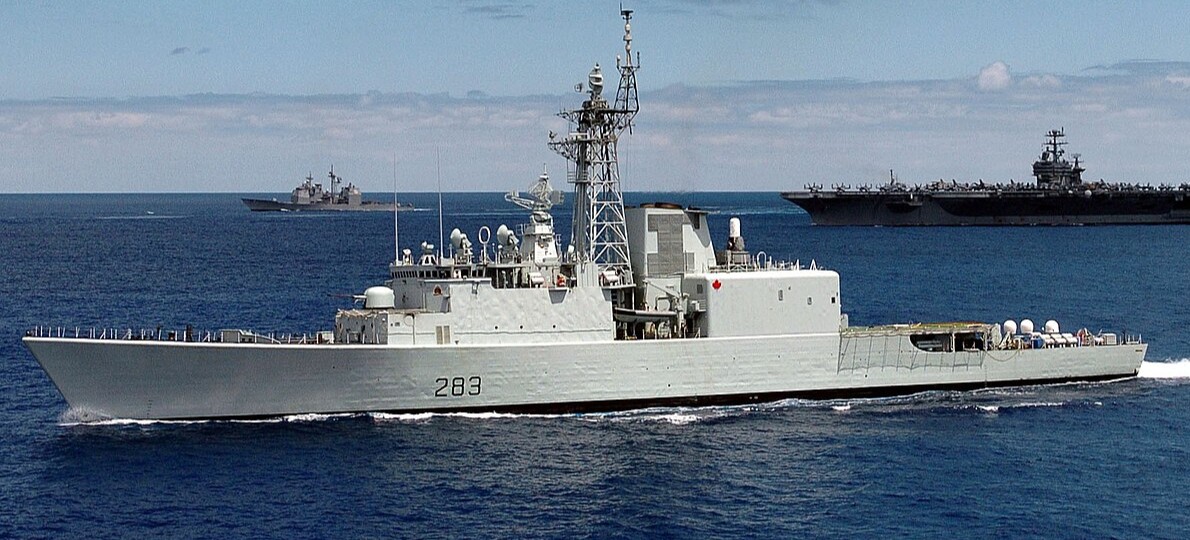
HMCS ALGONQUIN (DDG-283)
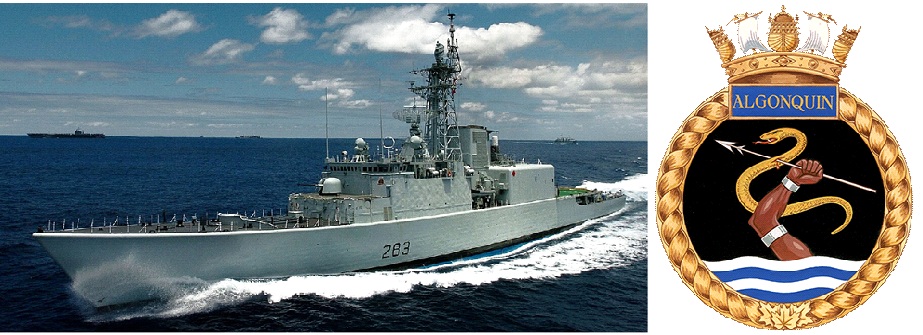
(U.S. Navy Photo by Photographer's Mate 2nd Class Jayme Pastoric)
OP SHARP GUARD 24 JUNE 1993 – 3 OCTOBER 1993
OVERVIEW:
Request ALGONQUIN provide perspectives of participating OP SHARP GUARD. Whatoperations was she conducting when her STANAVFORLANT mission was changed to OPSHARP GUARD?
· any “scary” ops? Boardings, ROEchallenges
· “ACTION STATIONS” for real? i.e.FRY EW simulated attack profiles?
· Notable Weather events
· Port visits? Significantvisitors?
· Stats - boardings, hails,diversions?
· Photos, press media?
Info from Posterity’s Sake: On 29 Mar 1993, ALGONQUIN sailed to join SNFL, again as flagship.
From Wikipedia: On 29 March 1993, Algonquin sailed to join STANAVFORLANT, arriving in April. She was once again made flagship and joinedthe other NATO vessels enforcing the blockade of the former Yugoslavia in theAdriatic on 24 Jun 1993 as part of Operation "Sharp Guard". On 2July, Algonquin conducted the first of a total of 88 merchantvessel boardings as part of the blockade. On 27 July, the busiest day for Algonquin boardingparties, seven merchant ships were boarded in a 23‑hour period. On 1 October,the ship completed her last boarding in support of the operation. On 5 October,Algonquin completed turnover of STANAVFORLANT to HMCS Iroquois andreturned home.
HMCS Algonquin in Operation SHARPGUARD June to October 1993
By: Cdr (ret’d) Paul C Leblanc, Commanding Officer
Produced: 27 August 2026
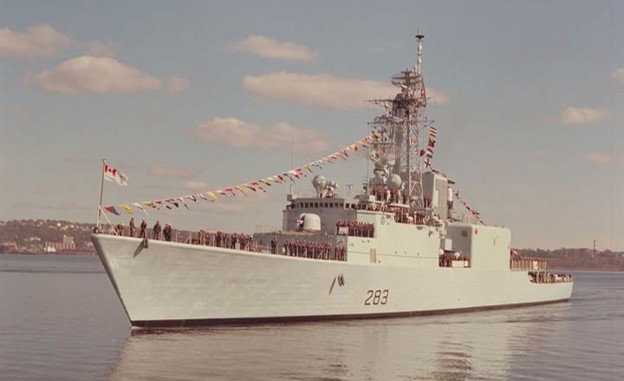
HMCS Algonquin DDH 283
Introduction
Introduction
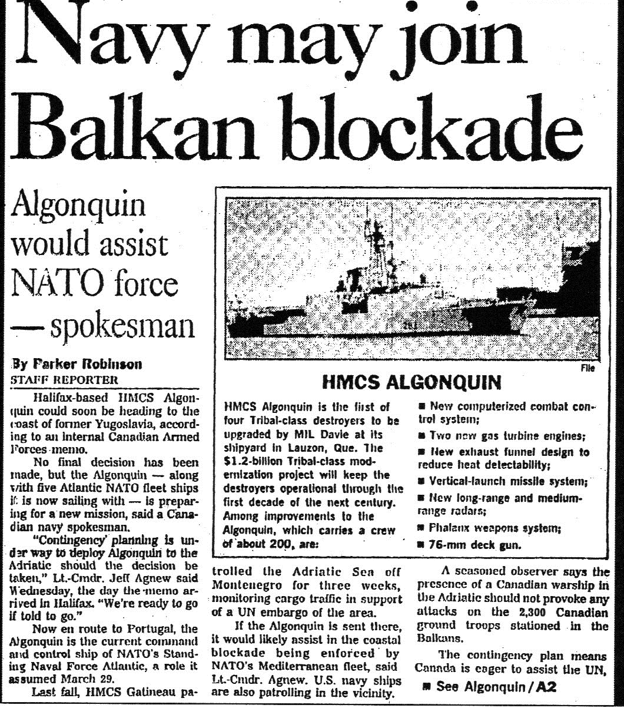
My involvement in Operation SHARP GUARD began with a posting message to HMCS Algonquin while in command of CFS St John’s. I handed over command to Cdr Mike Wickware on May 17th, 1993 and departed St John’s for Halifax two days later. On arrival at Halifax International Airport I picked up a copy of the Halifax Chronicle Herald that displayed a headline “Navy may join Balkan blockade” with the sub-title “Algonquin would assist NATO force”. This was news to me.
Later that day I called on my boss, Capt(N) Ron Buck, Commander Maritime Operations Group 5. He was responsible for all the operational ships in Maritime Forces Atlantic (MARLANT). He presented two important pieces of information:
1. Algonquin was already deployed to European waters as part of the Standing Naval Force Atlantic (SNFL) and NATO was considering deploying that squadron of 6-7 ships to Operation SHARP GUARD; and,
2. Since I lacked experience in our Iroquois-class destroyers, sometimes referred to as Tribal Class, he arranged for me to spend 10 days at sea in one of Algonquin’s sister ships, HMCS Iroquois, commanded by Cdr Lenny Edmunds.
I joined Iroquois the next day. She was the second of the Tribal class to undergo the mid-life modernization refit, Algonquin being the first of the four ships to do so. The refit, referred to as the Tribal Update and Modernization Programme (TRUMP), included a complete replacement of the ship’s weapon systems. The NATO Sea Sparrow self-defence missile system was replaced by the vertical launch Standard Missile with a maximum range of 90 nautical miles. A Vulcan Phalanx close-in weapon system was installed on top of the helicopter hanger with an autonomous fire control radar and a 20 mm cannon capable of firing 2000 rounds of depleted uranium per minute. The ship’s 5-inch Otto Melara main gun was replaced with a more modern Otto Melara 76mm general purpose gun, firing smaller rounds but with a higher rate of fire. The ship’s radars, air defence decoys, command and control system and internal communications were all replaced with more modern and capable systems.
The most significant engineering changes were the installation of four new gas turbine engines and a rather clever fuel tank management system that allowed sea water to enter the ship’s fuel tanks as fuel was consumed. The seawater acted as ballast and made the ships much more stable.
My ten days in Iroquois were most useful. I spent a lot of the time on the Bridge and in the Operations Room, focusing on the combat organization and control there of. I also spent a good deal of time below decks, accompanied by the various department heads so that I had the best possible understanding of the ship’s engineering and logistics.
Morale in Iroquois was top of mind for her command team (Cdr Edmunds, Executive Officer (LCdr Greg Romanow) and Coxswain) and I could sense a strong bond and general enthusiasm among the ship’s company. Seeing this was just as valuable to me as seeing the combat systems and I made up my mind that Algonquin would be a “happy ship”, a naval term for a ship with good morale.
Joining HMCS Algonquin
Going ashore from Iroquois, my last stop before departing for Europe to catch up with Algonquin was a call on the Commander MARLANT, Rear-Admiral Lynn Mason. The Admiral wished me well and gave me three limitations over and above whatever rules of engagement that would be forthcoming from NATO if/when SNFL joined the naval interdiction off the coast of the Former Republic of Yugoslavia (FRY).
· I was not to attempt opposed boardings (i.e. shoot our way onboard uncooperativemerchant ships);
· I was not to have our boarding party inserted by air (called fast-roping from a helicopter); and,
· I was not allowed to allow the ship’s helicopters (Sea Kings – tail numbers 428 and 437) to conduct military operations over land.
I believe these restrictions came from lessons learned during our Navy’s experience in the Gulf War that had taken place only two years previously.
On June 1st I travelled to Lisbon to join Algonquin. Oddly, I had to fly west from Halifax to Montreal before heading east to Lisbon. The flight was on a Portuguese airline with the movie and all announcements in Portuguese, not a language I speak. On arrival at the airport in Lisbon, I was grateful to see one of the ship’s drivers, Corporal Chris Madsen, waiting for me.
Reporting on board, I was met by the out-going Commanding Officer, Cdr J.Y. Forcier, who had been selected for promotion and would be attending the National Defence College (NDC) in Kingston. J.Y. was a fine officer who eventually rose to the rank of Vice-Admiral and Commander of Maritime Forces Pacific and subsequently Commander Canada Command in Ottawa. I was also re-acquainted with then Commodore Greg Maddison, Commander Standing Naval Force Atlantic. Algonquin had been the Flag Ship for the NATO formation for about a month, and Greg was to become my cabin mate in the Captain’s cabin until Algonquin left for Halifax four months later. He was a brilliant leader, well up to the challenges of integrating the NATO squadron into the pending operation in the Adriatic for which he received the Meritorious Service Cross. He was also a mentor and leadership example for me. He later became a Vice-Admiral and Deputy Chief of Defence Staff.
The ship itself was bursting at the seams with people. Aside from the regular ship’s company of about 260 and the NATO international staff of about 20, she carried a full Air Detachment to support the two Sea Kings and the usual smattering of trainees. Every one of the 315 bunks were occupied.
Some of the key ship’s officers were LCdr Paul Guindon (XO), LCdr Dan Sing (Combat Officer), LCdr Dan Banville (Supply Officer), LCdr Paul Hall (Combat Systems Engineer), LCdr Alex Reuben (Engineering Officer) and Lt(N) Jeff Steele (Deck Officer and Boarding Party Officer). Jeff was awarded the Meritorious Service Medal for his performance as Boarding Party Officer.
The other ships in the squadron were also present in Lisbon (US, British, Dutch, German, Spanish and so on). Notably, the Captain of the Federal German Ship Rommel was an old friend from previous NATO operations, Captain Hans Witthauer who later rose to the rank of Vice-Admiral.
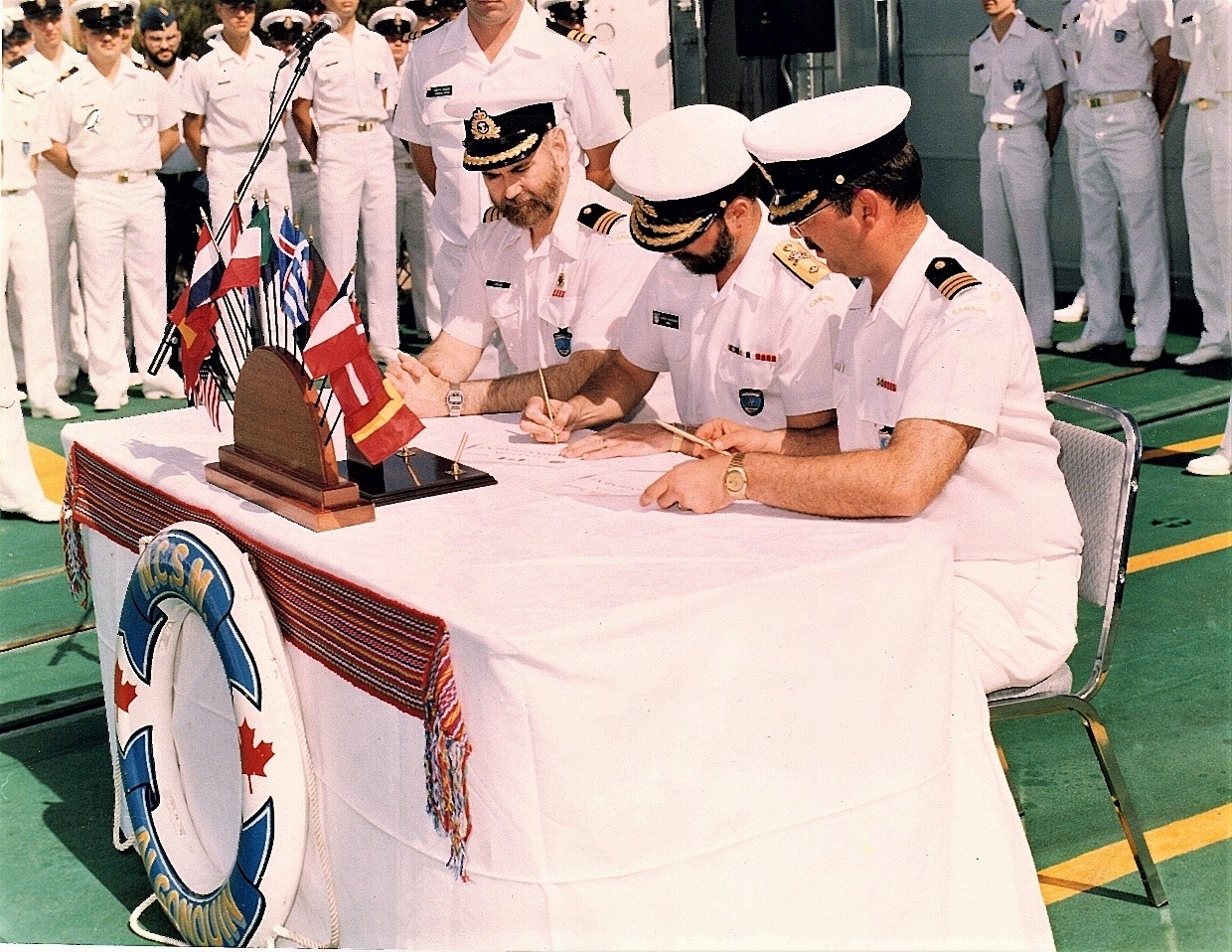
Change of Command Ceremony onthe flight deck while in Toulon.
Awaiting the Tasking
The squadron departed Lisbon two days after my arrival and sailed to Toulon where we conducted the change of command ceremony on June 5th and J.Y. departed the ship. During the transit from Lisbon to Toulon, I took the measure of the readiness and morale of the ship. Algonquin had been the first ship to emerge from the massive TRUMP mid-life refit and was in most respects an entirely new ship, albeit contained in a 20-year old hull. Her ship’s company was already exhausted by the rush to complete the myriad of sea trials, training and work-ups in time to meet the NATO commitment. There had been very little rest time in the year since she was delivered to the Navy by MIL Davie Shipyard in Quebec City. Even the Christmas leave period was abbreviated. As first of class, there were naturally a number of technical, engineering and operational issues that were ongoing. Litton Systems Canada was responsible for the installation and integration of a completely new combat system, consisting of Dutch radars, an Italian gun, an American close-in weapon system, British chaff-launchers, Canadian communications and anti-submarine warfare sensors and weapons. She carried a Litton factory representative, Mr. Tony Fry. He was invaluable for troubleshooting and rectifying glitches. He stayed with the ship until the end of the deployment, except that he had to disembark when the ship was in the operational zones of Operation SHARP GUARD.
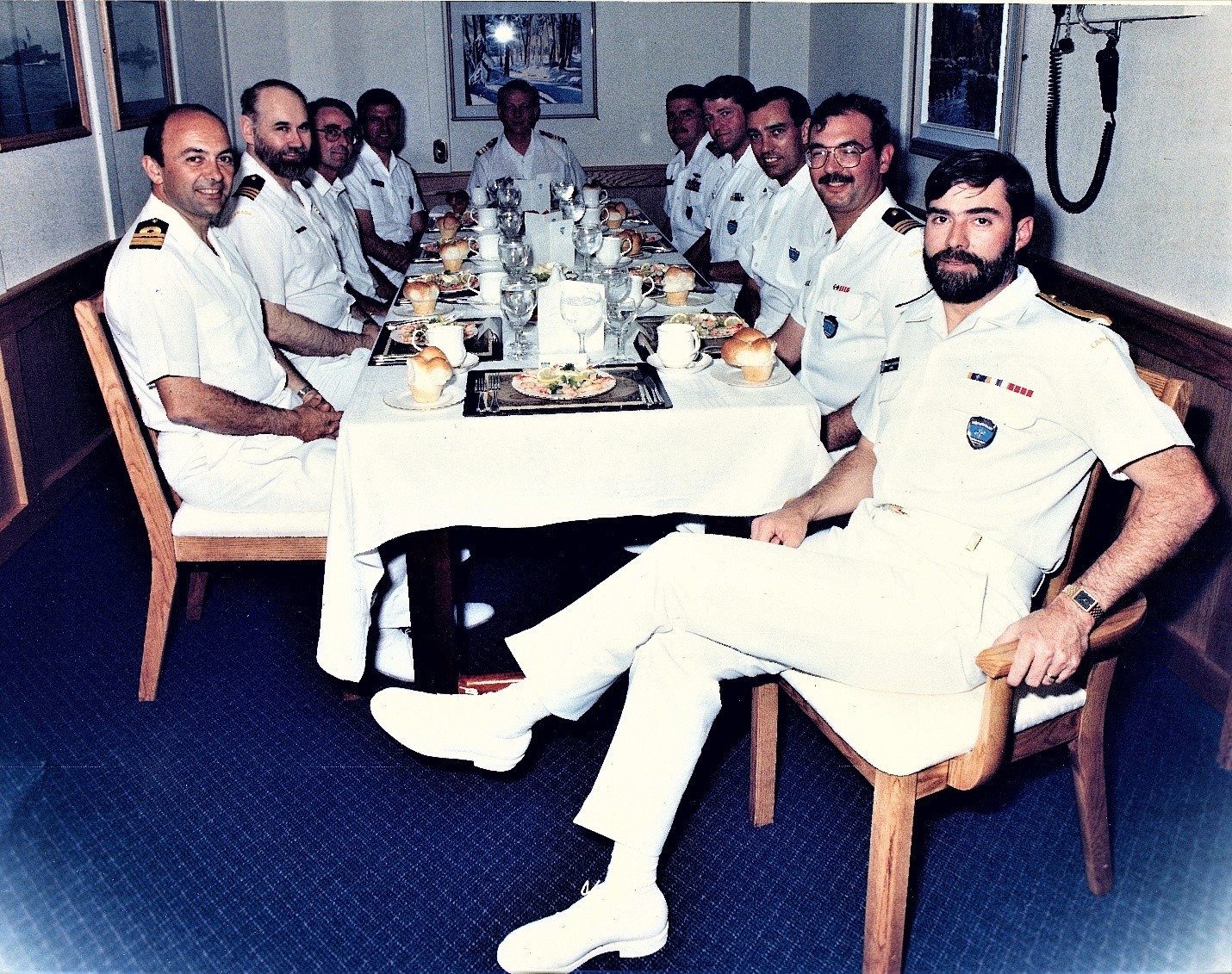
Commodore Maddison (rightforeground). Cdr Forcier to hisright. Myself second from the front onthe left. The other guests were commanding officers of SNFL ships.
The next port visit was Palmade Majorca, a pleasant Spanish Island in the Western Mediterranean, followed by a visit to Barcelona. While we were in Palma de Majorca we were informed that SNFL would be joining operations in the Adriatic under a United Nations Resolution to interdict the importation of war supplies to the Former Republic of Yugoslavia (FRY). Two groups of ships, each with 6-8 warships were already engaged in this interdiction. They were the Standing Naval Force Mediterranean and a recently assembled European formation known as the Western European Union task group. All those ships were from European navies. Two SNFL ships departed from Palma to relieve ships coming off station and the remaining ships, including Algonquin, conducted a port visit to Barcelona then followed in their wake.
On June 22nd, we anchored in the bay off Naples and Commodore Maddison and two of his staff as well as myself and my Combat Officer proceeded ashore by ship’s boat for briefings at NATO’s Southern Headquarters. Notably, we met with Italian Admiral Carlo Alberto Vandini (COMNAVSOUTH). My impression was that the Italians were running the show in the Adriatic, which is understandable given the geography. We were briefed on the existing patrol areas, standard procedures for hailing and boarding ships and rules of engagement. Tactical command of the operation would rotate between the three flag officers involved, including Commodore Maddison.
Commencing the Mission
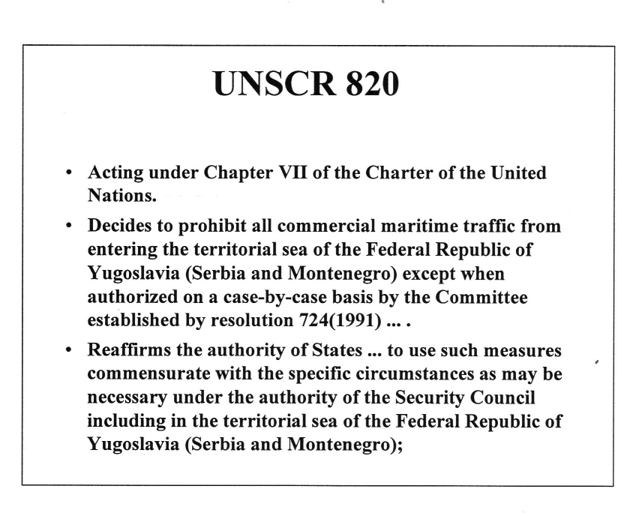
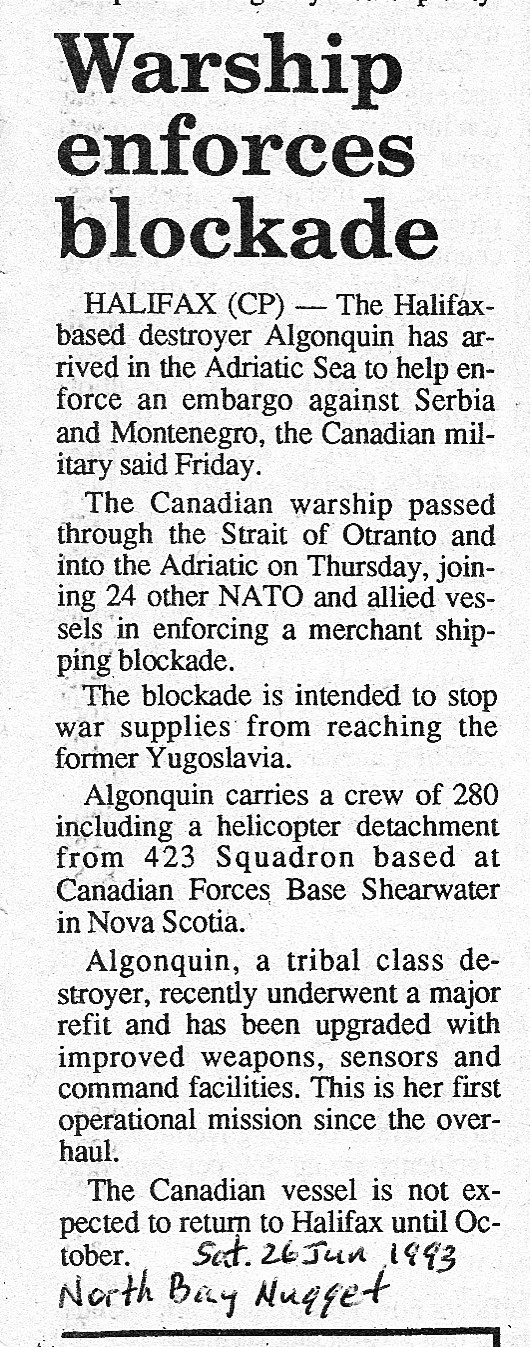
On June 24th, Algonquin andthe remaining ships of SNFL entered the Adriatic Sea.
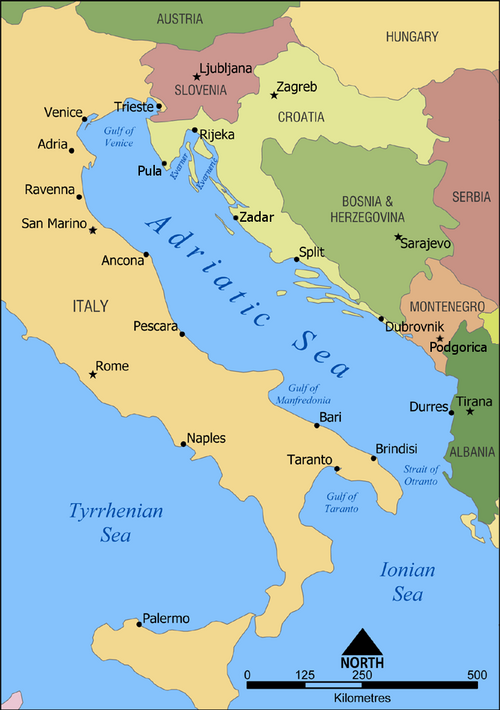
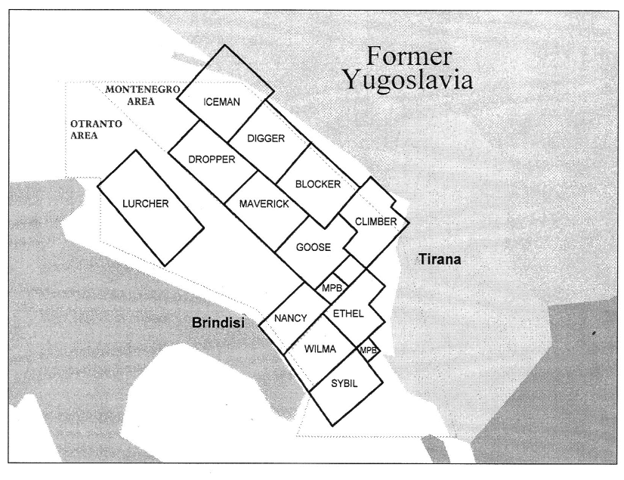
The waters bordering FRY were divided into patrol sectors. The four southernmost sectors were where most of the hailing and boarding operations took place. They were Nancy (north),Ethel (East), Wilma (West) and Sybil (South). The northern sectors along the shoreline of Croatia, Bosnia-Herzegovina, Montenegro, and Albania began at the 12-mile territorial waters of FRY and were established to prevent any vessels not cleared by higher command from entering FRY ports. These sectors (Iceman, Digger, Blocker and Climber) were assigned to coalition warships with good air defence capability due to the threat of shore-based anti-ship missile systems. Those systems occasionally radiated fire-control radars but did not follow through with any launches.
On arrival, Algonquin was assigned Sector Iceman where we relieved the Spanish warship Baleares.
Shortly after arrival, Commodore Maddison and myself were invited to the Italian Flag Ship Giuseppe Garibaldi for a briefing. Garibaldi was a small (14,000 ton) aircraft carrier and she was carrying the Officer in Tactical Command (OTC), Italian Rear-Admiral Pellegrino and his staff. This command position rotated regularly between the flag officers present in the area including Commodore Maddison. Our briefing can be summed up to say that the Italian Navy had charge of the operation for some time and had established procedures that we were to follow. For example, we were given a detailed checklist for hailing and boarding ships when stationed in the southern sectors.
During our time in Iceman followed by Digger, we maintained the second degree of readiness (one level below Action Stations) with our weapon systems immediately ready. I decided that I wanted a command-qualified officer on deck at all times so my XO and myself stood watches in the Operations Room. We did indeed intercept occasional and random fire control radar signals from shore-based missile systems and on one occasion, a Serbian frigate approached us from landward while radiating her fire control radar then turned back at the 12-mile territorial limit. We carefully remained 13 miles from the coast at all times to avoid any disputes about entering territorial waters. The only other FRY naval activity that we observed was forays by small warships between ports along the coast, especially between Split and Bar.
Allied warships numbered over twenty, with useful work for about seven at any one time so there was ample time for maintenance and crew rest and we took advantage of several interesting port visits, starting with a short re-visit to Toulon from 6-8 July and a longer visit to Marseilles from 8 to 17 July. On 14 July Several of us were guests of the French Navy at the Bastille Day Ceremony and were asked to wear high collar whites (which we had) and white gloves (which we had to procure in a hurry).
VIP Visit
When we departed from Marseilles we were pleased to have embarked the Minister of National Defense (MND), the Honourable Tom Siddon and the Deputy-Chief of Defence Staff Vice-Admiral Larry Murray. They had been ashore in Bosnia to visit Canada’s troops and were interested in the naval operations. An interesting opportunity presented itself to the MND. Canada was contemplating the purchase of the EH-101 maritime helicopter to replace the Sea Kings and there were new EH 101’s being built in Milano, Italy. The MND had arranged to visit Milano and as we passed Italy, off he went with one of our Sea King’s and flight crew for a 24-hour visit. On return the minister was thrilled to say that he and our pilot had been given an opportunity to fly in an EH-101 and that our pilot was allowed to fly the aircraft. Both the minister and the pilot spoke highly of the EH-101.
First Experience at Boarding Operations
On return to the operations area we were assigned to one of the southern sectors and conducted hailing and boarding operations. Our helicopters proved to be ideal platforms to seek out, identify and hail inbound vessels which we either cleared or boarded according to the protocols given to us by the OTC.
This type of work was much more interesting than patrolling the 12-mile limit. The bridge watchkeeping officers enjoyed the challenge of dashing into position to launch our boarding party and the members of the boarding party put their training to good use. It was not work for the faint-hearted. We ferried the sailors at high speed in our rigid hulled inflatable boat (RHIB), which was a mission-fit for this deployment and later became standard boats for the Iroquois class ships. On arrival at the merchant ships, the boarding party faced a climb of up to 80 feet up a chain and board ladder with a full load of body armour and weapons.
Next came three port visits in succession: Brindisi, Italy 10-14 August, Ismir, Turkey 17-23 August and a fueling stop in Souda Bay, Crete on 24 August. We were at anchor during the visit to Ismir and hired local passenger boats to allow the crew to enjoy some shore leave.
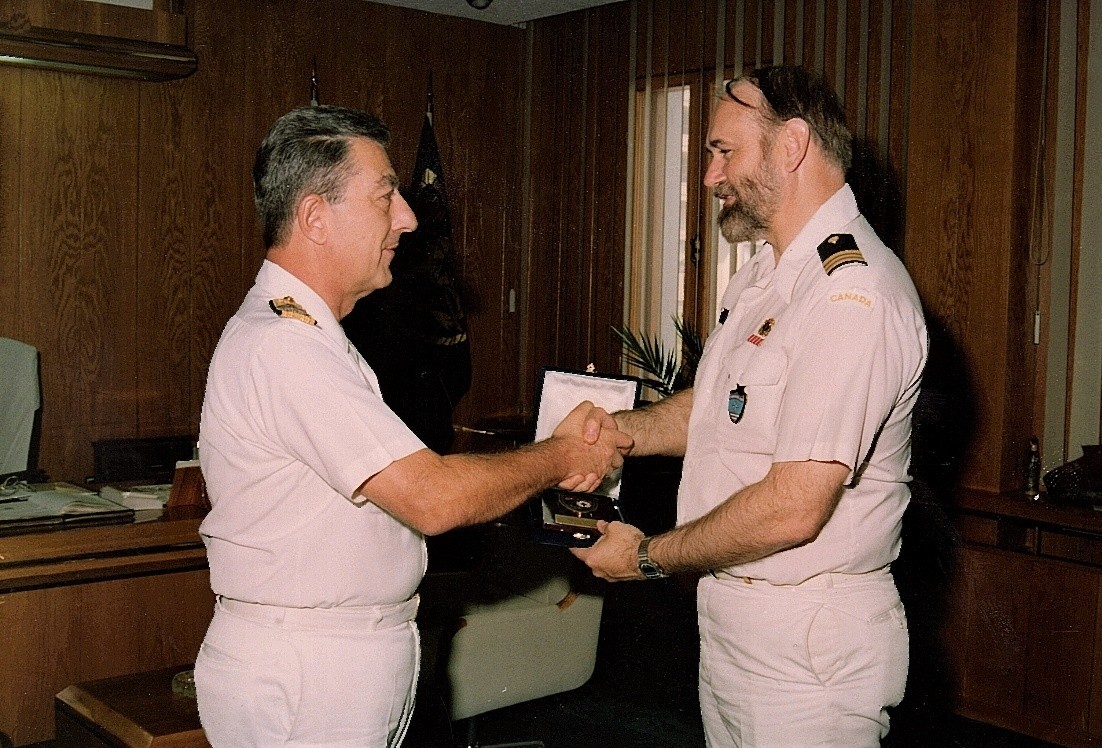
Official call on the TurkishNavy in Ismir. I always enjoyedtraveling with the Navy because we were treated so well by our hosts.
While in Brindisi we landed Sea King 428 for a main gearbox replacement. Support from the Sea King Squadron in Shearwater was tremendous throughout our deployment and this was an example. A new gearbox and several technicians had to be flown to Brindisi and arrangements made with the Italians to do the work atone of their military bases. As we passed Brindisi on the way back to the operations area, 428 flew out to re-join Algonquin.
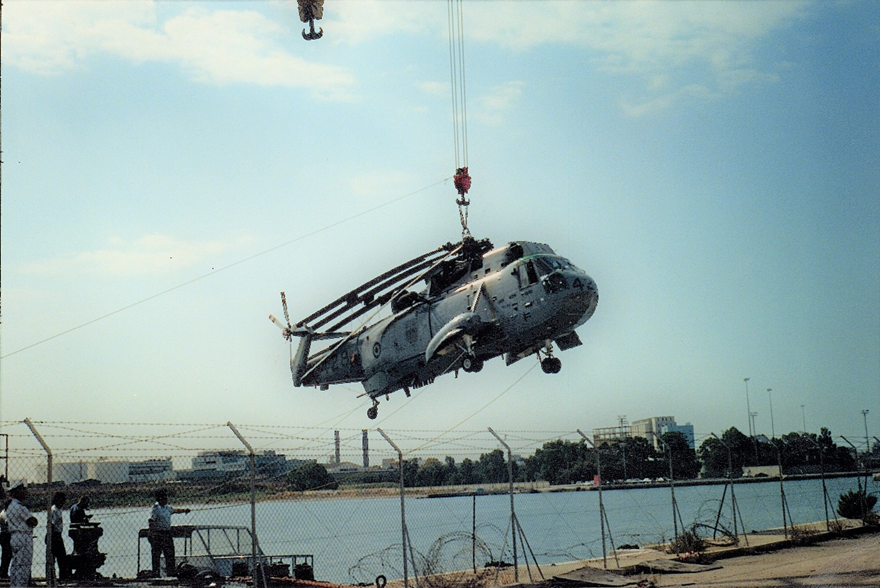
428 being craned off in Brindisi 10 Aug
Refugees
Our third patrol took place in Area Climber. Area Climber butted up against Albanian territorial waters and there had been numerous incidents of refugees fleeing the Balkans by boat in attempts to get to Italy. Just prior to entering Area Climber I was present at a short meeting with the OTC, an Italian admiral and several other Task Group ships’ captains where the refugee situation was discussed. Under international convention, ships are obliged to come to the rescue of craft in distress or in unseaworthy condition but the question was what to do with any rescued people. To deal with this possibility the Italian Coast Guard established a base in Durres, Albania and ships were directed to contact that base and arrange to hand over any refugees. The very next day in the early evening I received a call from the Officer of the Watch that a small open boat had hove into view, that it contained several passengers and that it did not look seaworthy. We approached the boat and launched our RHIB to investigate. It became obvious that the passengers were refugees and that it was doubtful they would survive a crossing of the Adriatic Sea. I made a satellite call to the Durres base, using a number given to us at the OTC’s meeting and was asked to rendezvous with an Italian Coast Guard vessel just outside Durres. Not wanting to muddy the waters with respect to asylum seeking, I decided not to embark the refugees but to safely escort them to Durres. The RHIB led the way with course corrections given from Algonquin and we followed close astern. It was a lengthy process at 3-4 knots in total darkness but eventually we tracked a patrol craft on radar leaving Durres and heading toward us. I was unable to establish radio contact but the RHIB handed over the boat and passengers. The patrol craft embarked the refugees then sank their boat with machine gun fire which was somewhat unnerving for all concerned.
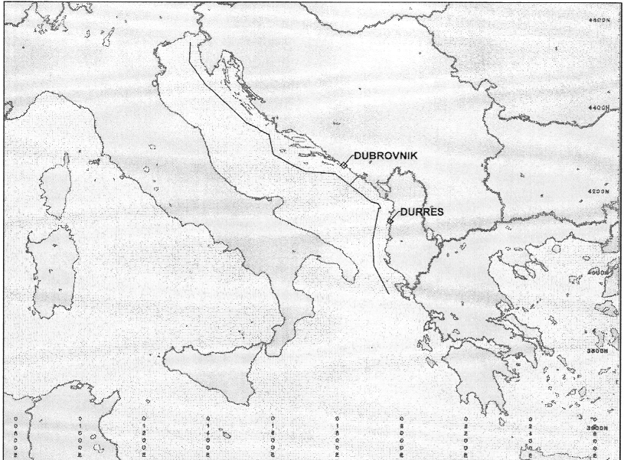
Further Patrols and Boarding Operations
The patrol in Area Climber was followed by a visit to Venice 6-12 September. We sailed through the Grand Canal at the centre of Venice and tied up at the cruise ship terminal.
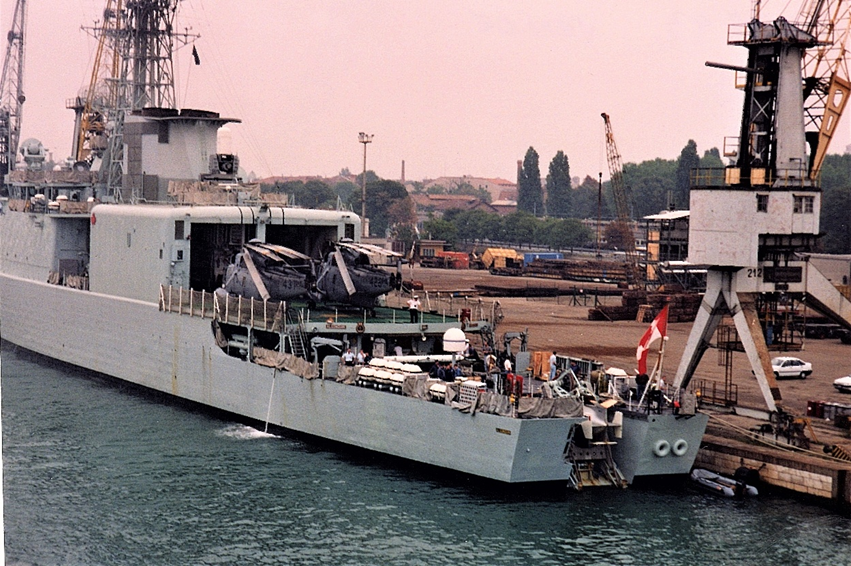
Alongside in Venice with both Sea Kings on the flight deck 6-12 Sep.
The visit to Venice brings me back to the topic of morale. The naval forces allocated by allies were sufficient to allow a good balance between operations, maintenance and crew rest giving us the opportunity to visit several interesting ports. Accordingly, ship’s company morale was on the way up. Another significant morale factor was the allowance for Home Leave Travel (HLT) that provided some public funding and special leave for family reunions, either back in Canada or in a country near the area of operations. Many of Algonquin’s ship’s company took advantage of this and we found ways to maintain a high level of readiness with about 10% of the crew on leave. The extra strain placed on those remaining in the ship was manageable. Throughout the operation, some of the crew put together a weekly TV show, mostly with comedic content involving interviews with various crew members including a tour of the Captain’s Cabin, “Lives of the Rich and Famous”. (You had to be there).
The operation itself, especially the interdiction and boarding operations, gave a high degree of satisfaction that we were accomplishing something, another big factor in crew morale.
During the port visit to Venice, I received an unusual phone call from Major-General John-Arch MacInnis, Deputy Commander of the UN Protection Force in the Former Yugoslavia. I had met the General previously during my tour at CFS St. John’s when I called on him during a visit to Halifax in his role as Regional Army Commander. On that occasion we discussed the Station’s mission to provide logistics support to the Army Reserve in Newfoundland.
This call was to discuss whether Algonquin could be made available for peace talks with the combatants in the Balkan situation. Regrettably, the ship was undergoing some extensive engineering repairs that precluded an immediate departure back into theatre but it would have been interesting!
Next, back to our familiar Area Climber for a few days then south to the Strait of Otranto sectors where we boarded quite a few merchant ships, finishing the patrol and our mission with 88 boardings.
It was during this period that we suffered our only casualty of the deployment. Our boarding party was searching a merchantship when Ordinary Seaman Martel, while moving along a deep cargo deck in dim lighting, fell 20 feet onto a steel deck and suffered multiple fractures. He was airlifted to a hospital ashore by one of our Task Force helicopters, a British Lynx along with our chief medic then repatriated to Canada.
Practical Experience with Rules of Engagement
During this patrol we had our first and only frustration with the mission rules of engagement when we had a small merchant ship refuse to respond to radio calls or slow to be boarded. The ship was headed north and we were unaware of her destination or cargo so she was selected for boarding and search. The protocol for this situation was to fire warning shots across her bow then if necessary to radio the ship that rounds would be fired into the ship if she did not submit to being boarded.
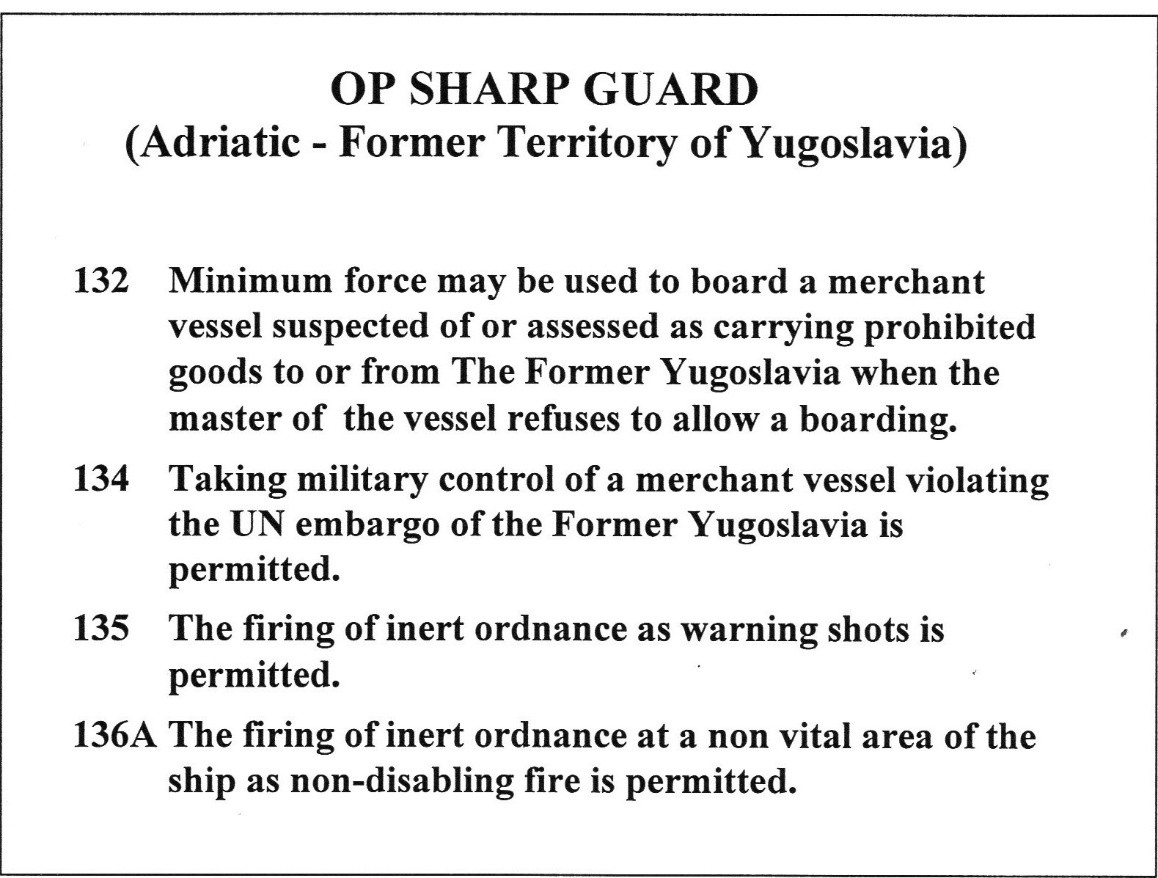
This ROE was not delegated to individual ships but rested with the OTC, who at that time was Commodore (RN) Ross operating from the Flag Ship HMS Edinburgh.
Accordingly, my request to fire warning shots was submitted to the Flag Ship where upon I received a call from Edinburgh’s Commanding Officer, my good colleague Commander Nigel Overington. Nigel responded that the Commodore had flown ashore to a staff meeting (in Naples I believe) and had not delegated authority for Nigel or any of the Commodore’s staff to approve any ROE requests. Commodore Maddison, who was at that same meeting, related to me a few days afterwards that a messenger arrived at the meeting with my ROE request and after a short discussion it was denied and I was advised to use a ruse tactic to persuade the ship to comply. I was to promise a brief visit by my boarding team with a cursory search and clearance to proceed. On arrival my boarding party was to seize the ship and take it to the nearby Italian port of Bari where it would be held in custody until released by Italian authorities. This tactic worked and we delivered the ship to Bari. It seemed somewhat underhanded to me but it worked.
End of Mission and Transit Home
On 01 or 02 October, Algonquin was detached from Operation Sharp Guard. Commodore Maddison and his staff transferred to another ship, we topped up our fuel tanks from one of the tankers and set sail for Palma Majorca where we were to meet HMCS Iroquois and hand over the Canadian role in Sharp Guard. It was nice to see Commander Lenny Edmunds and his ship’s company again, remembering my two weeks in Iroquois to prepare me for command of Algonquin.
We stopped at St. John’s on our way home in order to clear Canadian Customs and give the ship’s company one more interesting port visit. I took the opportunity to send one of the Sea Kings ahead of us to embark the Honourable Frederick William Russell, Lieutenant-Governor of Newfoundland and Labrador and his wife Margaret. His Honour was an RCAF pilot during the Second World War, an Honorary RCAF Colonel and a great supporter of the Navy during my time at CFS St. John’s.
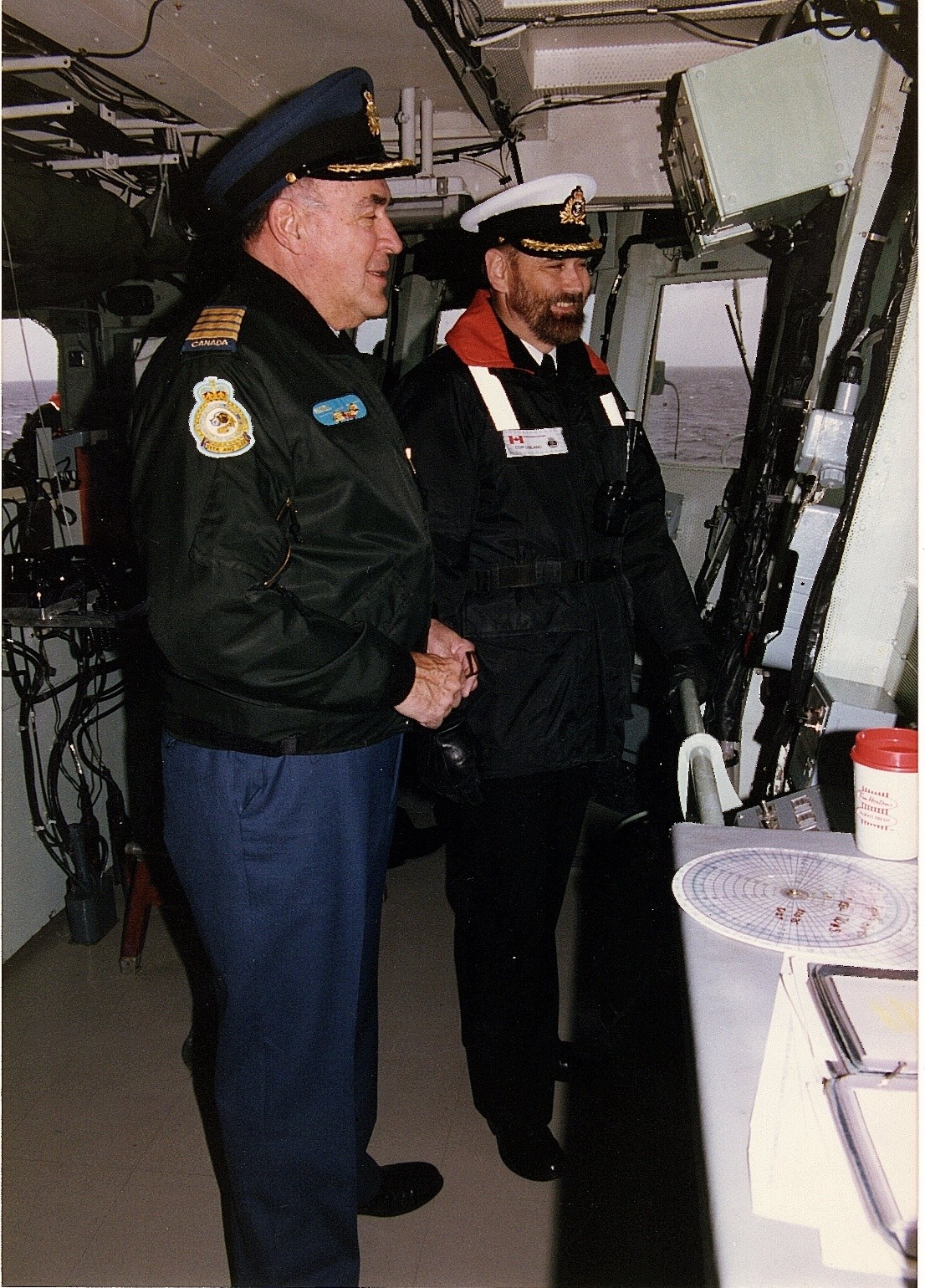
Lt. Gov Frederick Russell onthe Bridge
We received a rousing welcome in Halifax two days later with the Stadacona Navy Band and 200 Algonquin family members cheering for us. RAdm Mason who I had called on just prior to deploying came aboard to thank the ship’s company and welcome us home.
Thus ended Operation Sharp Guard for Algonquin. All crew members who had spent the requisite number of days in the operational area were awarded the NATO medal for the Former Yugoslavia and the Canadian Peacekeeping Service Medal.
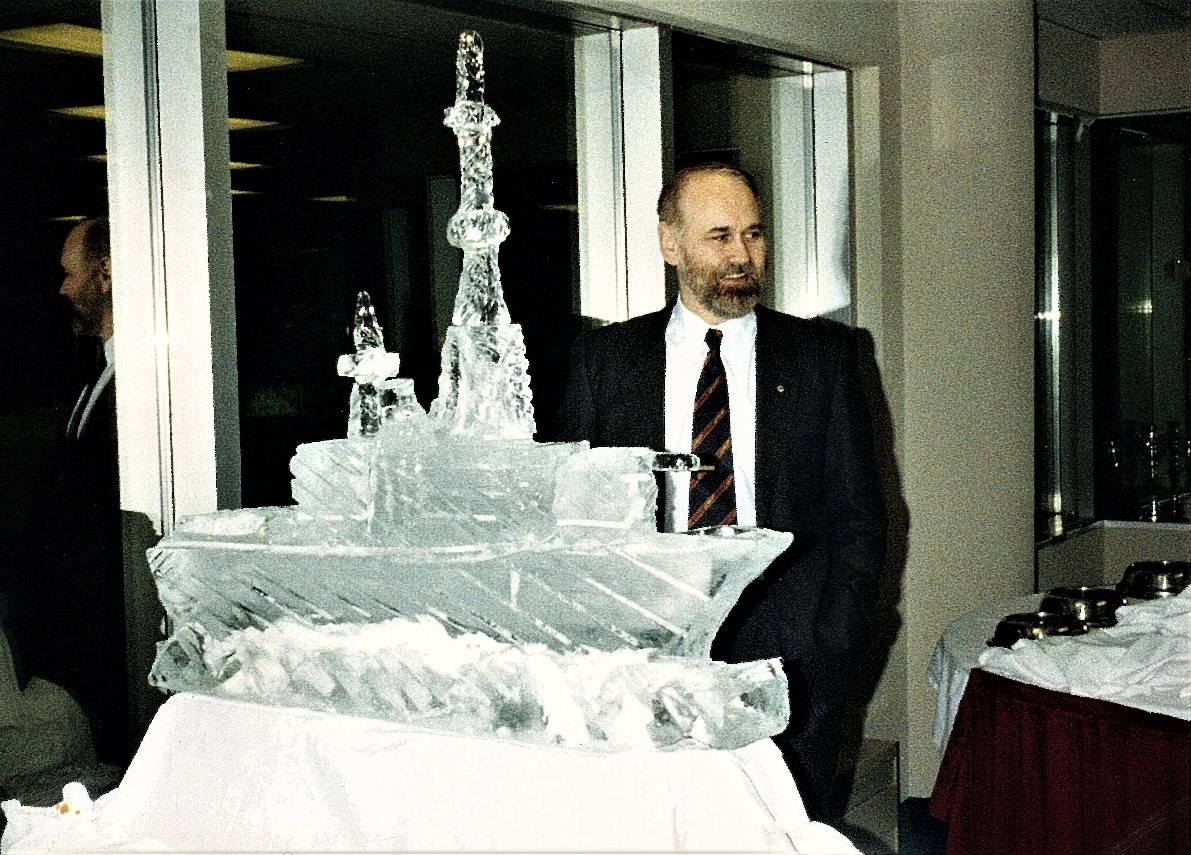
Ship’s company dance shortlyafter our return to Halifax. Moralemission accomplished.
Post script. Algonquin was transferred to the Pacific sixmonths after our return to Halifax and myself and most of Algonquin’s crewformed the crew of HMCS Athabaskan, just emerging from the TRUMP refit.
HMCS Algonquin Port Visit Schedule Operation Sharp Guard 1993
30 May – 1 Jun Lisbon
05 Jun – Toulon
9-12 Jun – Palma Majorca
17-20 Jun – Barcelona
22 Jun - Naples
24 Jun – Enter the AdriaticSea
6-8 Jul - Toulon
08-17 Jul – Marseilles
10-14 Aug – Brindisi
17-23 Aug – Izmir
24 Aug – Souda Bay, Crete
25 Aug – Brindisi
06-12 Sep Venice
13-15 Sep Brindisi
04-06 Oct Palma Majorca
13-14 Oct St John’s
_4.jpg)
(U.S. Navy photo by Mass Communication Specialist 2nd Class Rebecca J. Moat)
The Canadian Iroquois-class destroyer HMCS Algonquin (DDH 283)

Have feedback or a story to share?